Moving Beyond 'Talking in Circles'
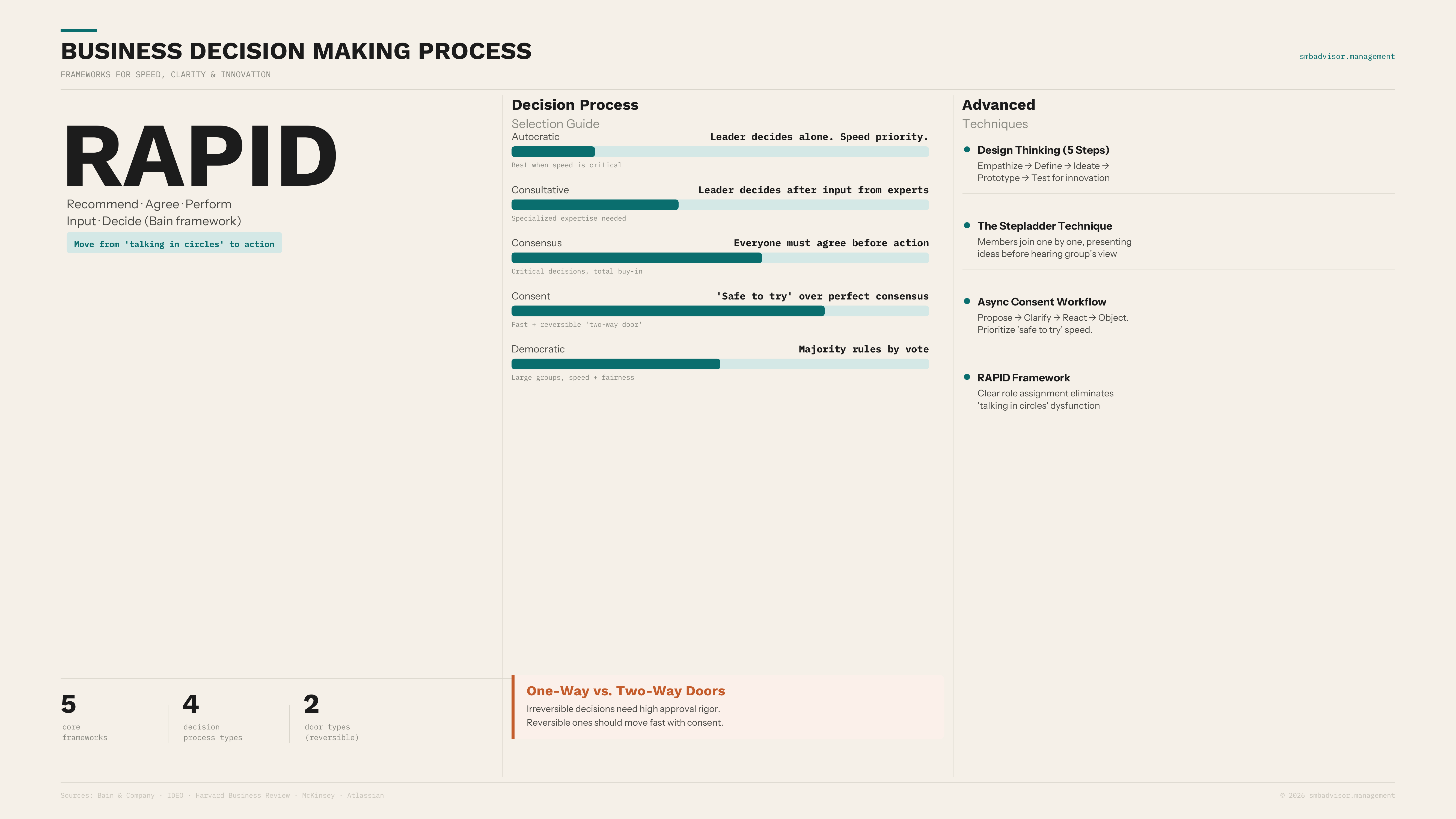
Research shows that organizations with defined decision-making processes, including clear ownership, explicit criteria, and documented outcomes, make faster and higher-quality decisions than those that approach decisions ad hoc, regardless of the intelligence of the individuals involved. The RAPID framework from Bain assigns clear roles to every decision: who Recommends, who must Agree, who Performs, who provides Input, and who ultimately Decides. This role clarity eliminates the circular discussions that plague organizations where decision rights are ambiguous. The framework works for decisions at every scale from team-level choices to enterprise strategy.
Decision Process Selection
Five process types serve different contexts. Autocratic decisions work when speed is the highest priority. Consultative processes use expert input while maintaining efficient decision authority. Consensus requires total agreement and is appropriate only for critical, high-stakes choices. Consent-based processes prioritize "safe to try" speed for reversible decisions. Democratic voting serves large groups where both speed and perceived fairness matter.
One-Way vs. Two-Way Doors
Amazon's framework distinguishes between irreversible decisions (one-way doors) requiring high scrutiny and rigorous approval, and reversible decisions (two-way doors) that should move fast with lightweight consent processes. The most common organizational failure is treating two-way door decisions with one-way door rigor. This creates bottlenecks and decision fatigue that slow organizational momentum.
Sources: Bain & Company, IDEO, Harvard Business Review, McKinsey, Atlassian