Change Communication Plan

Mastering the Strategic Framework

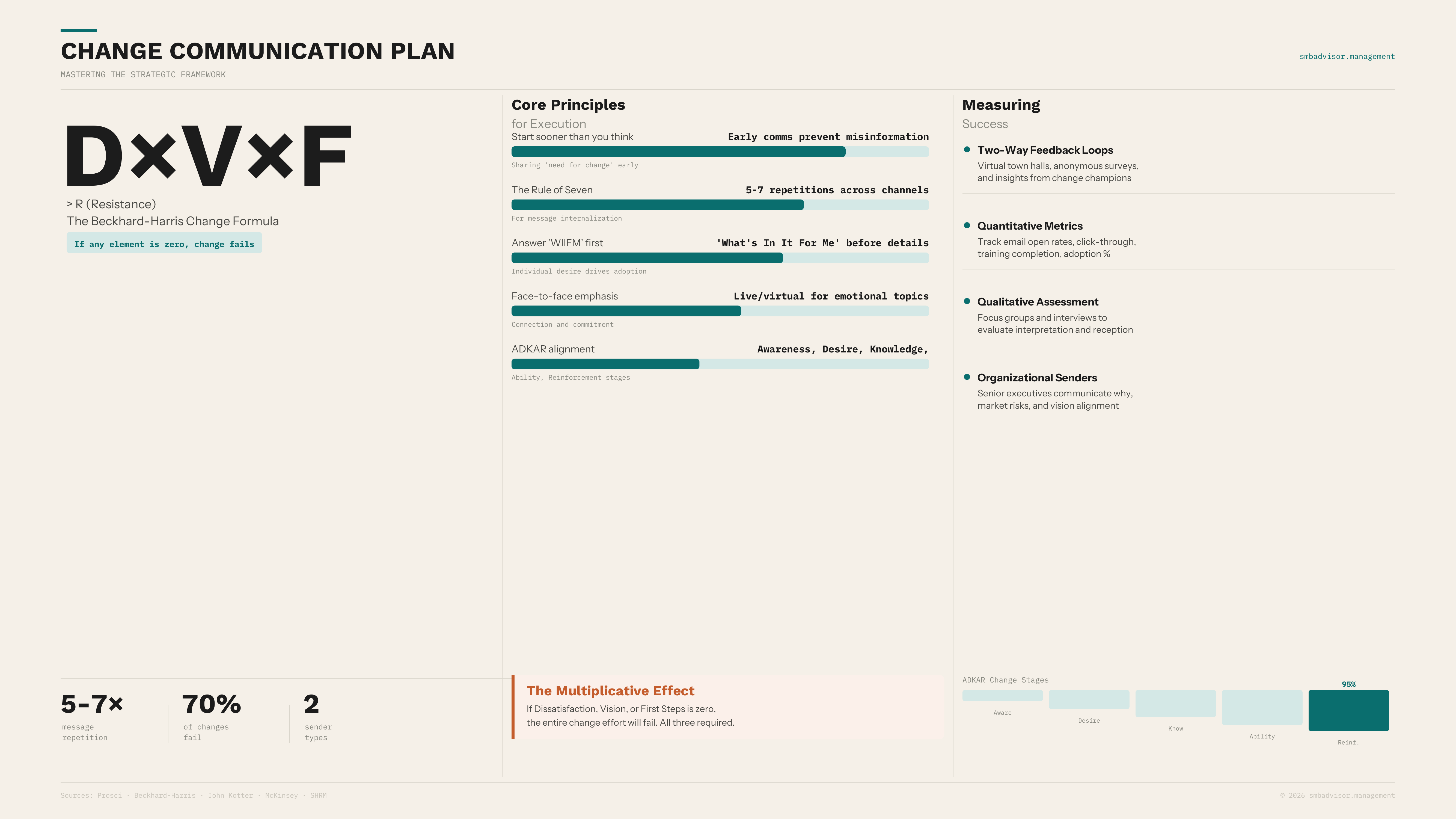
Change Communication Plan Infographic — of organizational change initiatives fail to achieve their goals
Share:

The Physics of Change

Most organizational change initiatives fail not because the change itself is wrong but because communication about the change is insufficient, delayed, or inconsistent , leaving employees to fill information gaps with speculation that amplifies resistance. The Beckhard-Harris Change Formula states that Dissatisfaction times Vision times First Steps must exceed Resistance for change to succeed. The multiplicative nature is critical: if any single element is zero, the entire effort fails regardless of the strength of the other elements. Seventy percent of change initiatives fail, and the formula explains why.

Core Execution Principles

Start communicating sooner than comfortable. Early communication prevents misinformation and is always more effective than silence. The Rule of Seven requires key messages to be repeated 5-7 times across multiple channels for internalization. Answer "What's In It For Me" before presenting technical details, because individual desire drives adoption more than organizational logic.

Measuring Success

Two-way feedback loops through virtual town halls, anonymous surveys, and change champion networks provide qualitative signal. Quantitative metrics track email open rates, click-through rates, training completion percentages, and adoption curves. The ADKAR framework (Awareness, Desire, Knowledge, Ability, Reinforcement) provides stage-gate measurement, with communication plans primarily impacting the Awareness and Reinforcement stages.

Sources: Prosci, Beckhard-Harris, John Kotter, McKinsey, SHRM
Frequently Asked Questions

What should a change communication plan include?

A change communication plan should include the rationale for the change in terms of business outcomes (not just organizational preference), a timeline with specific milestones, a description of what changes for each audience segment, named channels and spokespeople for each communication, a feedback mechanism for employee questions, and a cadence for progress updates after implementation begins.

How do you communicate change without creating resistance?

Resistance is reduced when employees receive communication before rumors form, when the rationale addresses what employees actually care about rather than organizational benefit alone, when leaders demonstrate that they have heard concerns through behavioral response, and when employees have a specific channel to ask questions and receive direct answers.

How early should you communicate organizational change?

Communicate change as early as you have enough information to answer the basic questions: what is changing, why, when, and what it means for the audience. Waiting for perfect information typically means waiting too long , employees learn about changes through informal channels before leadership communicates, which consistently increases resistance.

Share This Infographic

Copy the embed code below to share on your website with attribution.

Published by World Consulting Group. Need expert guidance on operations, strategy, or scaling your business? Get in touch.