How Small Businesses Use ChatGPT
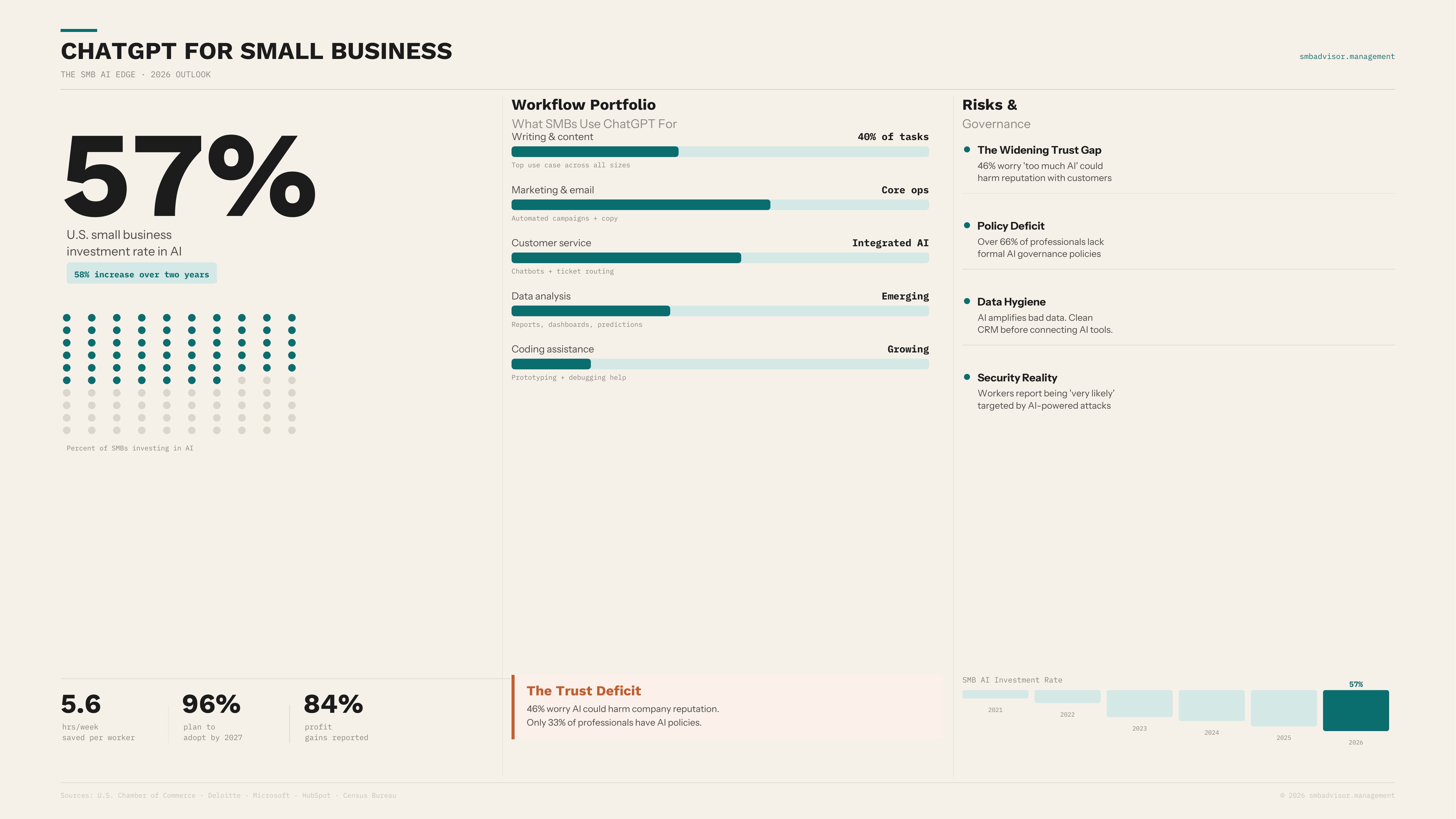
ChatGPT for small business means using a generative AI chat assistant to draft, summarize, and research text for daily work. A Census Bureau survey fielded from November 2025 to February 2026 found that 19.1% of US firms with 1 to 4 employees had staff using generative AI.
Writing leads the list. Among those small firms, 83.6% used generative AI for writing or editing and 50.9% for searching for information. A US Chamber of Commerce survey of 3,870 firms under 250 employees found 44% used a generative AI chatbot at work in 2025. The two surveys ask different questions of different samples.
What Controlled Studies Measured
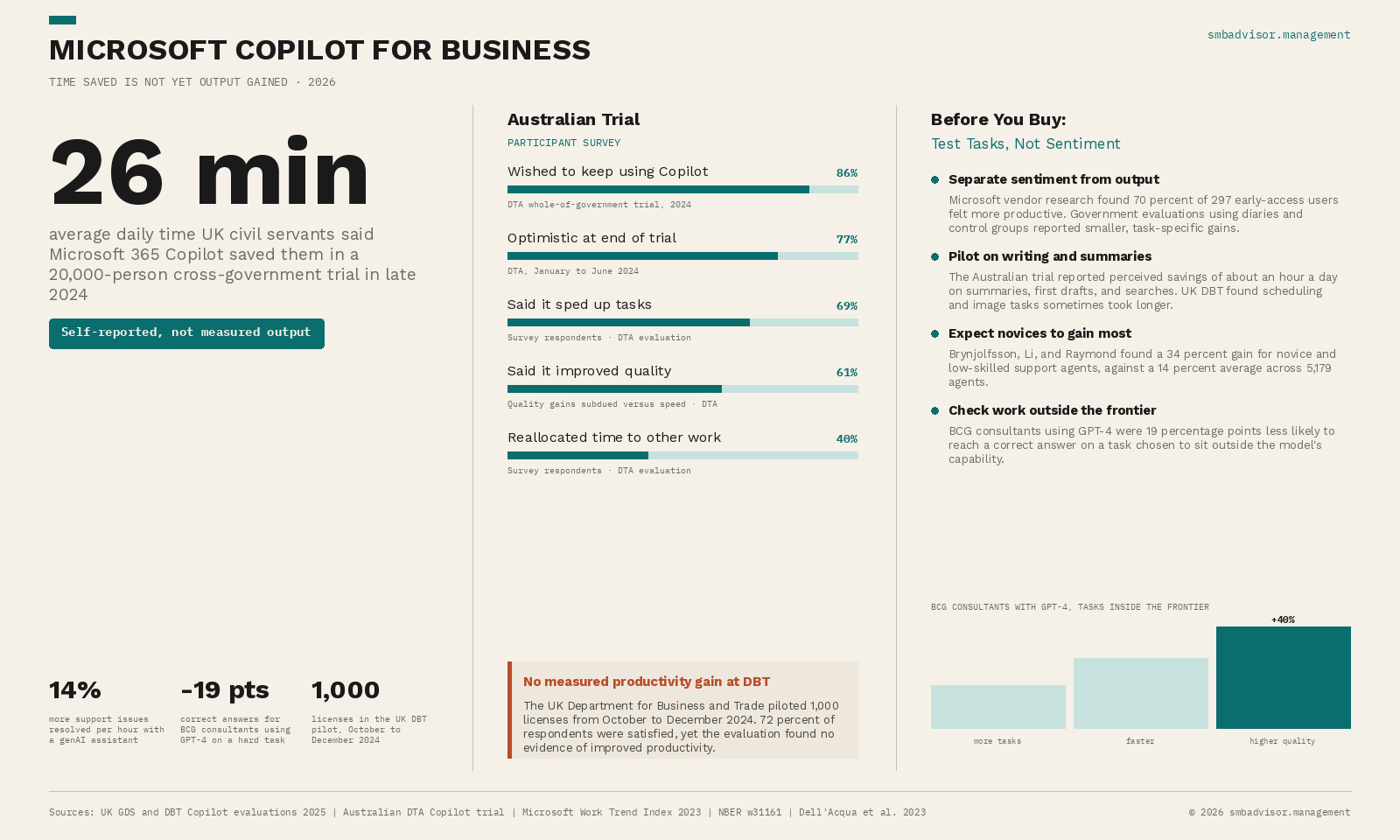
In a preregistered experiment published in Science, 453 college-educated professionals completed short writing tasks. Those randomly given ChatGPT finished in 40% less time, and output quality rose 18%. The tasks were incentivized tests, not small business fieldwork.
Danish register data show a slower picture. Humlum and Vestergaard linked surveys of 25,000 workers in 7,000 workplaces to official records. Two years after launch, they ruled out effects on earnings or recorded hours larger than 2%.
Governance Risks: Confidential Data and Accuracy
Staff often adopt chat assistants before an owner sets rules. In Danish workplaces with no encouragement, tools, or training, about 40% of workers in exposed jobs had still used AI chatbots. A written rule on confidential data entry closes that gap.
Accuracy is the second risk. In a peer-reviewed 2024 study, GPT-4 produced legal hallucinations 58% of the time on verifiable federal court questions. Treat every output as a draft and check facts, figures, and citations before use.
Sources: Noy and Zhang, Science 2023, US Census Bureau Business Trends and Outlook Survey AI Supplement 2026, US Chamber of Commerce Empowering Small Business 2025, Humlum and Vestergaard, NBER 2026, Dahl et al., Journal of Legal Analysis 2024, Chatterji et al., NBER 2025