The Revenue Impact
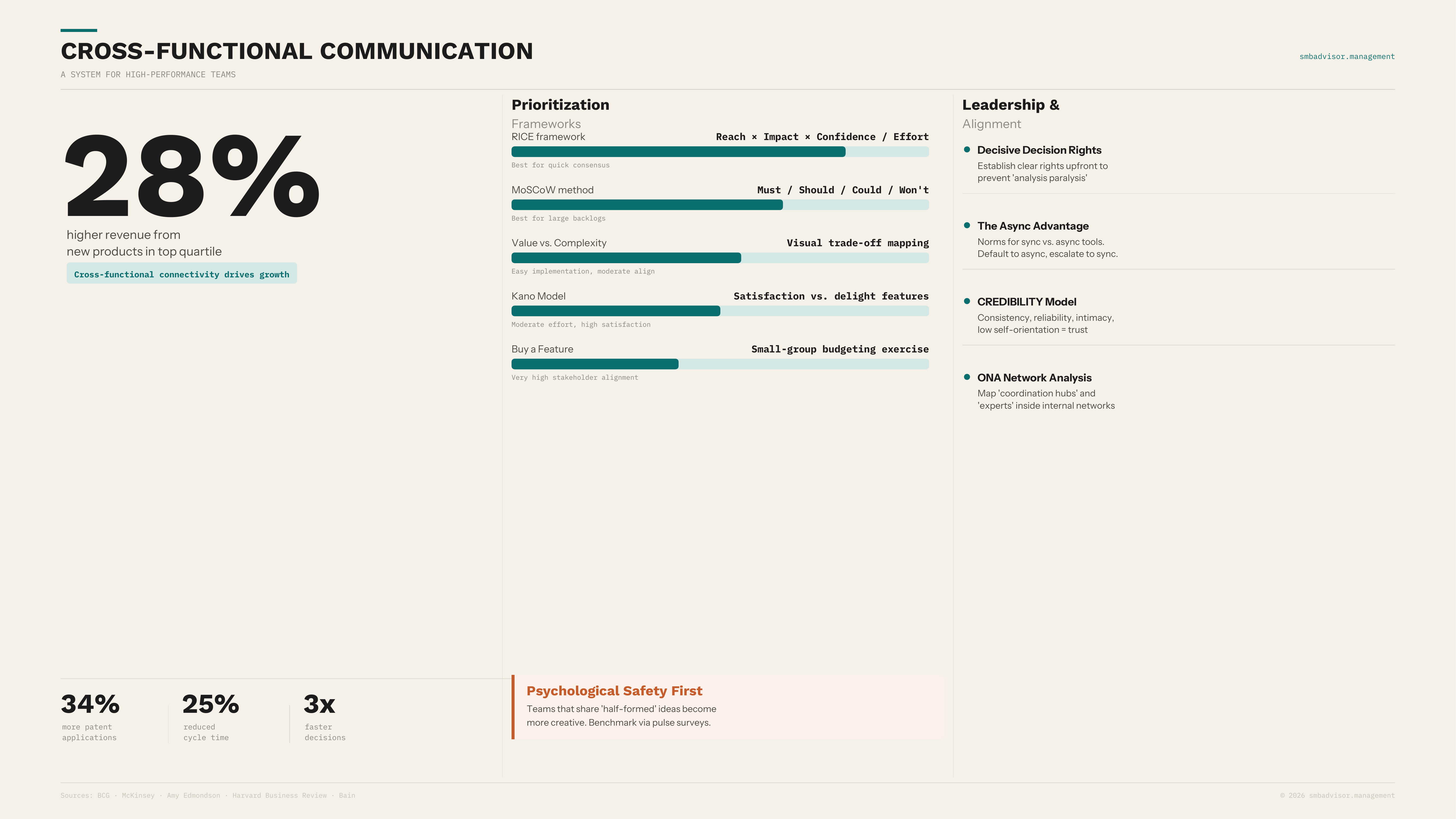
Cross-functional communication breaks down most often at the point of project handoff between departments, where differing success metrics, unclear ownership, and inconsistent meeting cadences create information gaps that delay decisions and erode accountability. Companies in the top quartile of cross-functional connectivity generate 28% higher revenue from new products, file 34% more patent applications, and reduce prioritization cycle times by 25% compared to organizations using unstructured methods. These gains compound over time as communication infrastructure strengthens collaboration velocity.
Prioritization Frameworks
The RICE framework (Reach, Impact, Confidence divided by Effort) delivers quick consensus on requirements. MoSCoW (Must, Should, Could, Won't) handles large backlogs effectively. The Value vs. Complexity matrix provides easy visual trade-off mapping. Kano Model analysis separates satisfaction drivers from delight factors. Each framework suits different decision contexts, and high-performing teams match the tool to the decision type.
Psychological Safety as Foundation
Teams where members feel comfortable sharing half-formed ideas consistently outperform teams focused on polished presentations. Leaders can benchmark psychological safety through pulse surveys measuring whether mistakes are held against people, whether diverse opinions are welcomed, and whether asking for help is easy. Establishing decision rights upfront prevents analysis paralysis.
Sources: BCG, McKinsey, Amy Edmondson, Harvard Business Review, Bain