The Scale of the Problem
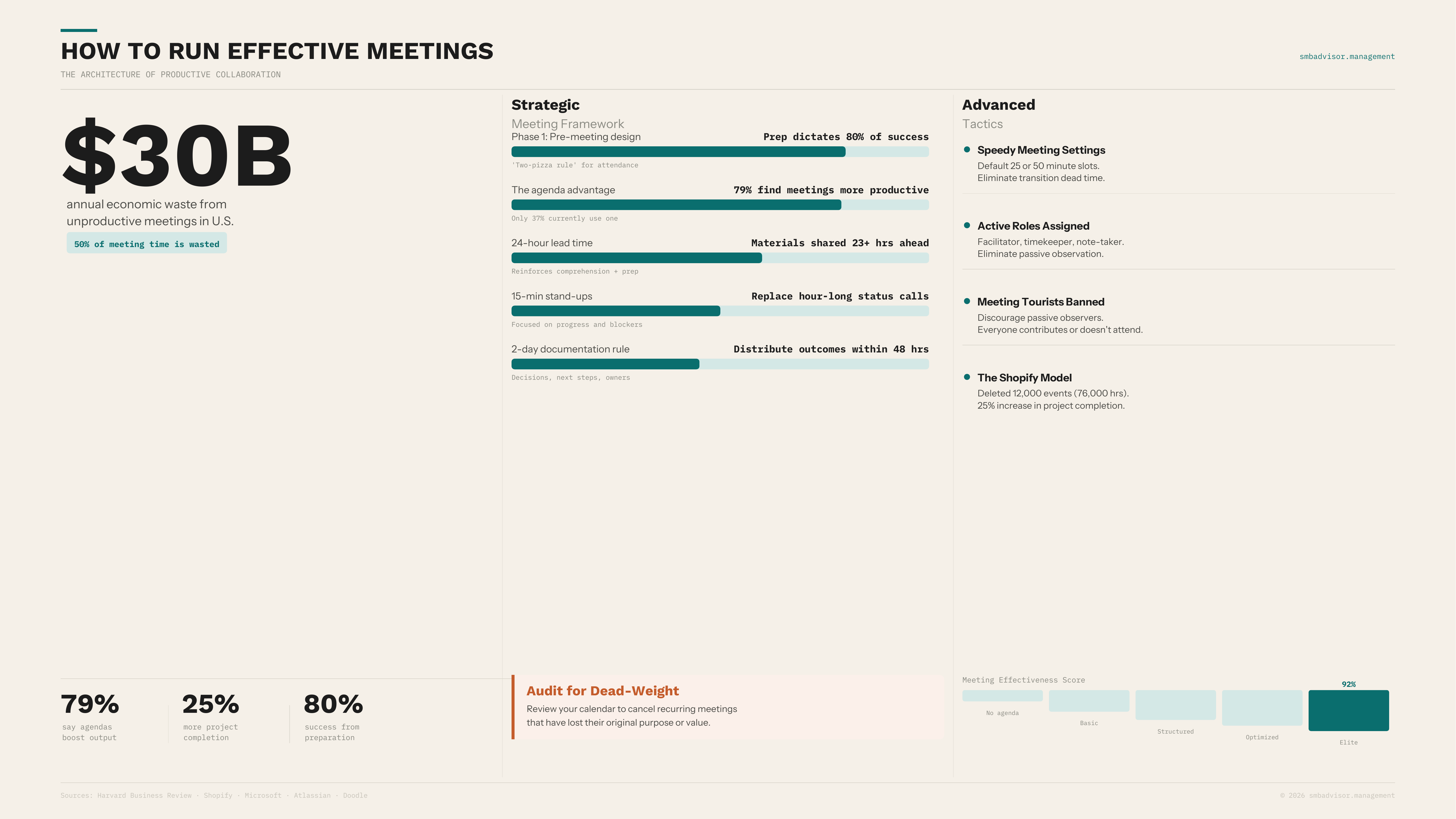
An effective meeting has a written agenda distributed at least 24 hours in advance, a clearly stated decision or outcome required from the session, a named facilitator responsible for keeping the group on track, and a written summary of decisions and owners distributed within one hour of adjournment. Unproductive meetings waste an estimated $30 billion annually in the U.S. alone. Fifty percent of meeting time is considered unproductive by participants. Yet 79% of professionals say meetings with structured agendas are significantly more productive. Shopify demonstrated the solution at scale by deleting 12,000 recurring events, freeing 76,000 hours and increasing project completion by 25%.
The Strategic Meeting Framework
Preparation dictates 80% of meeting success. The 'two-pizza rule' caps attendance at the number of people two pizzas can feed. Materials shared 24 hours in advance reinforce comprehension and enable meaningful contribution. Fifteen-minute stand-ups replace hour-long status calls, focusing exclusively on progress updates and blocker identification.
Advanced Tactics
Default to 25 or 50-minute time slots to eliminate transition dead time. Assign active roles: facilitator, timekeeper, and note-taker. Ban 'meeting tourists' who observe without contributing. Distribute documented outcomes including decisions made, next steps, and owners within 48 hours. Conduct quarterly calendar audits to identify and eliminate recurring meetings that have lost their original purpose.
Sources: Harvard Business Review, Shopify, Microsoft, Atlassian, Doodle