What Small Business AI Solutions Involve
Small business AI solutions are AI tools built into daily work, backed by trained staff, clear rules, and redesigned steps. Buying a tool is the easy part. In an OECD survey of over 5,000 SMEs in seven countries, 23.6% of generative AI users reported that employees take part in AI-related training.
Most small firms also leave their processes unchanged. Among AI-using US firms with 10 to 19 employees, 63.9% made no changes to use AI, according to Census data. That keeps AI as an add-on rather than part of how the work runs.
Measured Barriers: Skills, Data, Cost, and Trust
In the OECD survey, 57.3% of non-users said generative AI did not suit their work. Concerns about copyright or legal issues followed at 54.1%, data handling at 52.5%, and staff skills at 49.8%.
Cost ranks lower in the survey data. Among US firms with 10 to 19 employees and no AI plans, 7.3% cited expense and 23.0% cited a lack of knowledge about AI capabilities. Knowledge gaps are the larger measured barrier.
How Small Firms Move from Trial to Routine Use
Employer action is associated with higher adoption. In a Danish study of 25,000 workers, 41% used AI chatbots with no employer initiative, and 93% did where encouragement, enterprise tools, and training were combined. That study covers exposed occupations in firms of all sizes.
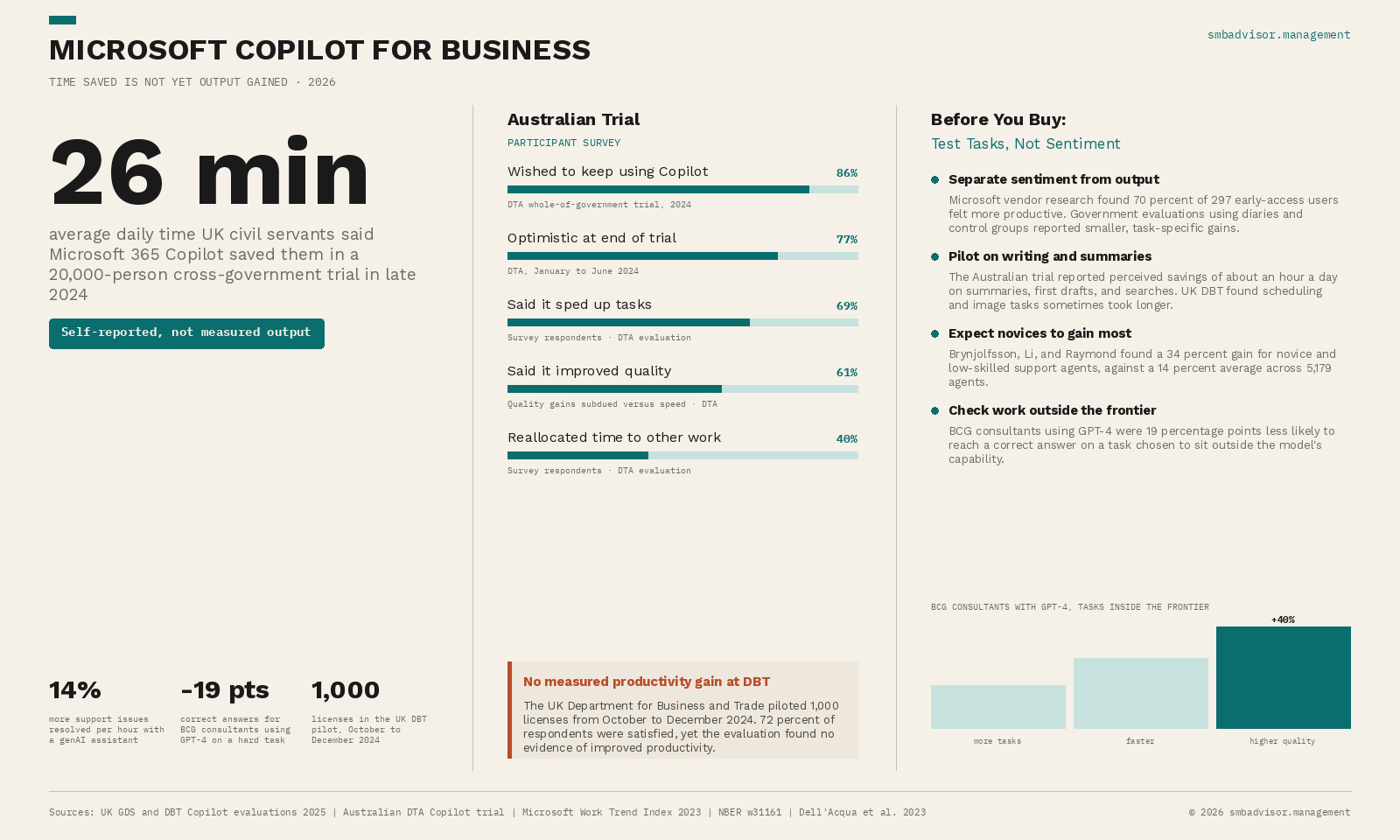
AI assistance helped newer staff most. At one large firm, an AI assistant raised issues resolved per hour by 14% among 5,179 support agents, and by 34% for novice workers. Pair each AI solution with written guidelines, task-based training, and one redesigned workflow.
Sources: OECD, Generative AI and the SME Workforce 2025, US Census Bureau BTOS AI Supplement 2026, Humlum and Vestergaard, NBER Working Paper 33777, Brynjolfsson, Li and Raymond, NBER Working Paper 31161