Small Business Communication

The High Cost of Silence · Strategic Framework

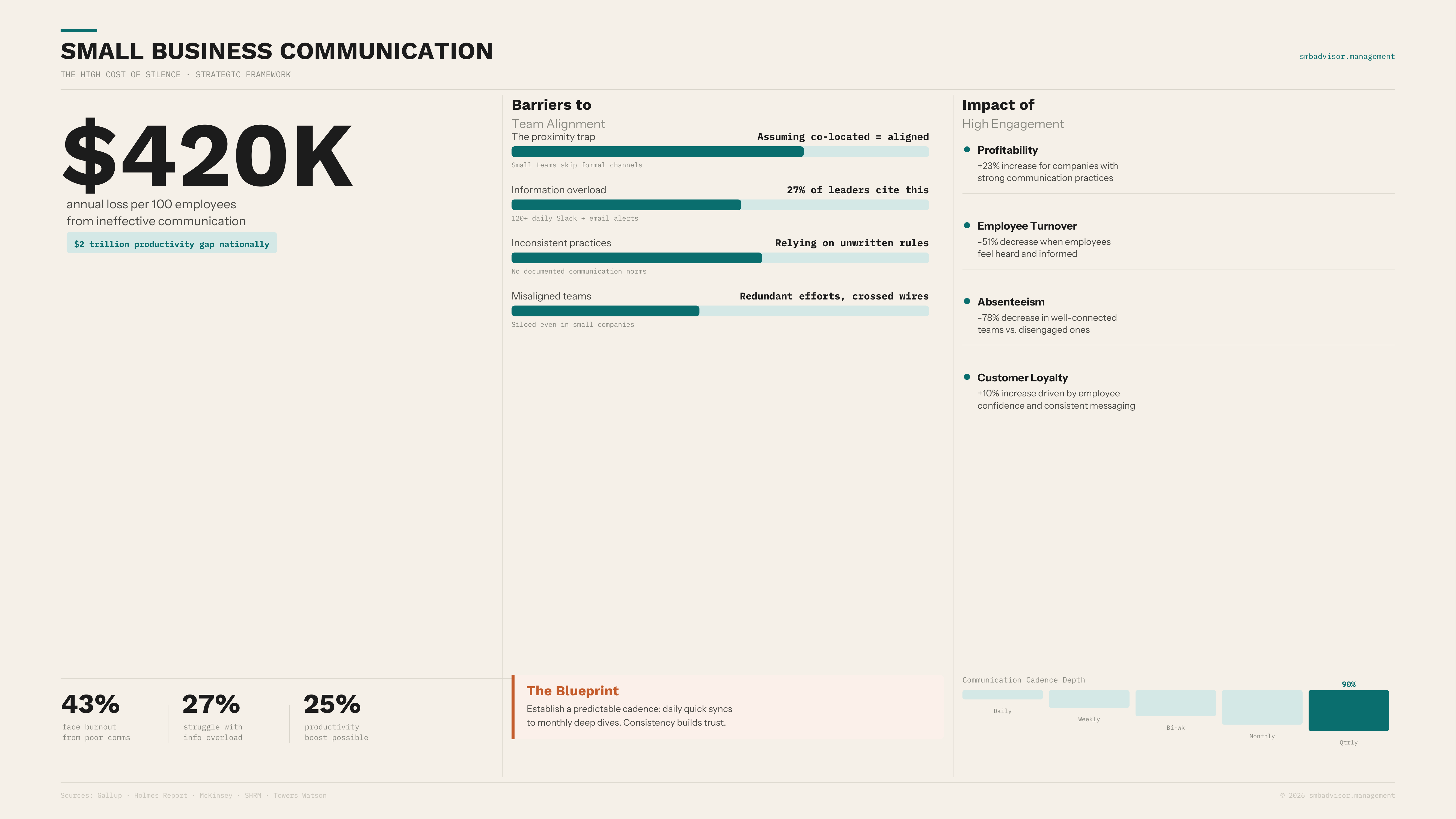
Small Business Communication Infographic — annual loss per 100 employees from ineffective communication
Share:

The Financial Impact

The most expensive small business communication failure is the absence of written decision records , forcing owners and managers to re-explain priorities repeatedly, relitigate settled decisions, and resolve misalignments that written documentation would have prevented. Ineffective communication costs organizations approximately $420,000 per year for every 100 employees, contributing to a $2 trillion national productivity gap. Forty-three percent of employees face burnout directly attributed to poor communication practices, and 27% of leaders struggle with information overload from fragmented channels.

Common Barriers

The proximity trap leads small teams to assume that physical co-location equals alignment, causing them to skip the formal communication structures that prevent misunderstanding. Information overload from 120-plus daily Slack and email notifications fragments attention. Inconsistent practices based on unwritten rules rather than documented norms create confusion as teams grow.

The Engagement Dividend

Companies with strong communication practices see 23% higher profitability, 51% lower employee turnover, 78% less absenteeism, and 10% higher customer loyalty. The foundational fix is establishing a predictable cadence: daily quick syncs, weekly team reviews, bi-weekly project updates, monthly strategic deep dives, and quarterly business reviews. Consistency in rhythm builds trust faster than any single communication initiative.

Sources: Gallup, Holmes Report, McKinsey, SHRM, Towers Watson
Frequently Asked Questions

What are the biggest communication problems in small businesses?

The most common small business communication problems are undocumented decisions (leading to recurring misalignment), owner-dependent information flow (creating bottlenecks when the owner is unavailable), inconsistent meeting cadences (alternating between too many and too few based on crisis), and conflating communication with information-sharing rather than decision-making.

How do you improve communication in a small business?

Start with one structural change: require that every significant decision be written down with a named owner and a deadline, distributed to relevant team members. This single practice eliminates the majority of recurring misalignments. Layer in a weekly all-team meeting with a consistent agenda after the documentation practice is established.

When should a small business formalize its communication processes?

Formalize communication processes when the team exceeds 5 people, when the owner is spending more than 2 hours per week resolving misalignments that should not have occurred, or when a hire is made into a role that requires coordination with multiple team members. Waiting until breakdown is the most expensive approach.

Share This Infographic

Copy the embed code below to share on your website with attribution.

Published by World Consulting Group. Need expert guidance on operations, strategy, or scaling your business? Get in touch.