Workplace Communication Strategies

Future-Proofing 2025-2026 · The Strategy Roadmap

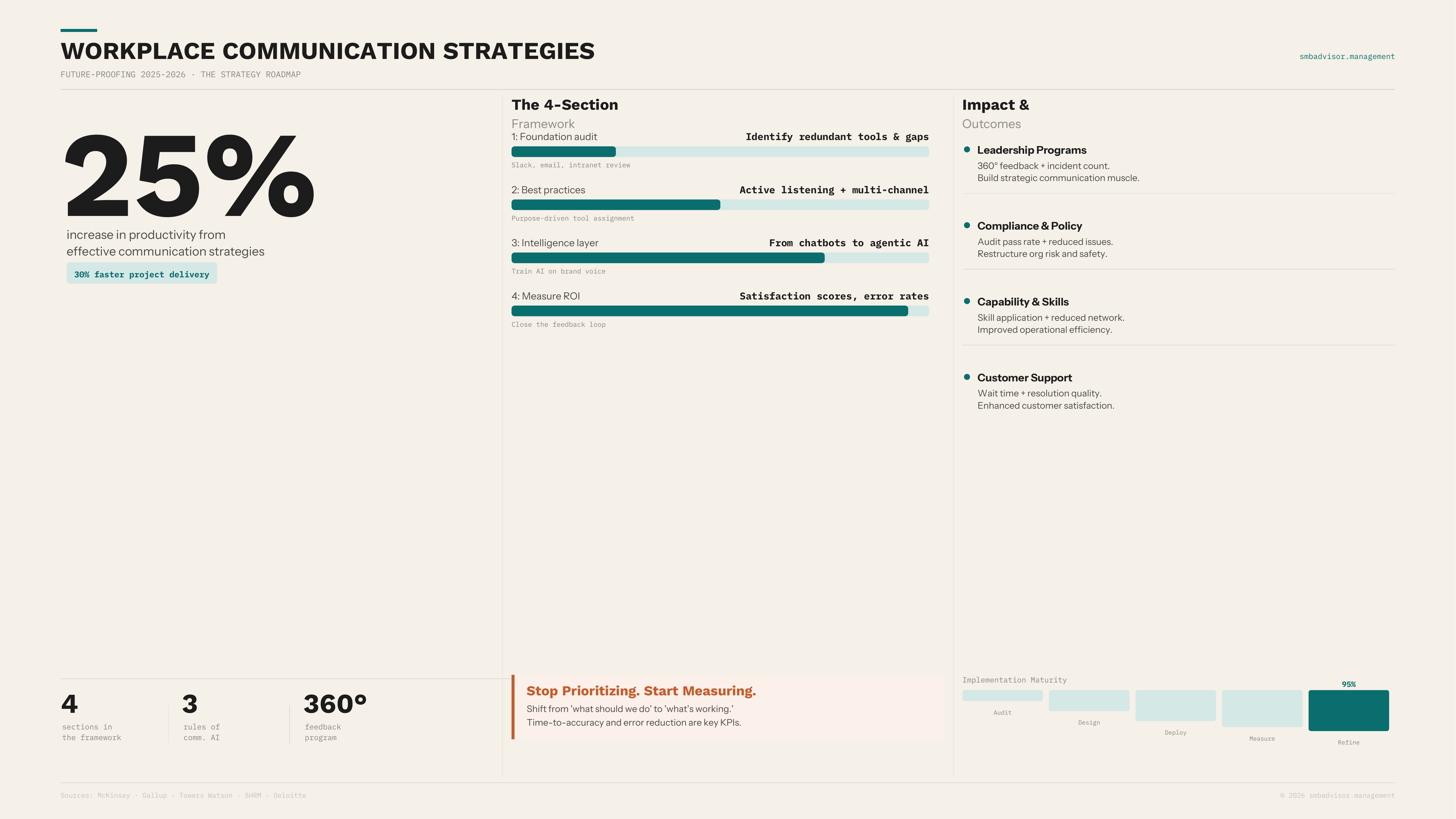
Workplace Communication Strategies Infographic — increase in productivity from effective communication strategies
Share:

The 4-Section Framework

High-performing teams use structured communication cadences : weekly team meetings, monthly all-hands, and quarterly strategy reviews, combined with written decision logs and explicit ownership assignments for every action item discussed. Section 1 conducts a foundation audit to identify redundant tools and infrastructure gaps across Slack, email, and intranet channels. Section 2 establishes best practices including active listening and purpose-driven multi-channel assignment. Section 3 integrates the intelligence layer, evolving from basic chatbots to agentic AI trained on brand voice. Section 4 measures ROI through satisfaction scores, error reduction, and feedback loop closure.

From Prioritizing to Measuring

The shift from "what should we do" to "what is working" marks the difference between aspirational communication strategies and operational ones. Time-to-accuracy and error reduction rates serve as the primary KPIs. Close the feedback loop by demonstrating how employee input has directly informed changes.

Program Outcomes by Type

Leadership programs track 360-degree feedback scores and incident counts. Compliance and policy programs measure audit pass rates and reduced organizational risk. Capability development tracks skill application rates and network efficiency improvements. Customer support programs focus on wait time reduction and resolution quality enhancement.

Sources: McKinsey, Gallup, Towers Watson, SHRM, Deloitte
Frequently Asked Questions

What are the best workplace communication strategies?

The highest-impact workplace communication strategies are a tiered meeting cadence (weekly operational, monthly strategic, quarterly planning), a single documented source of truth for decisions and action items, explicit norms for which communication belongs in which channel, and a culture of writing decisions down rather than relying on meeting memory.

How does workplace communication affect productivity?

Poor workplace communication costs organizations an average of $62.4 million per year in lost productivity for companies with 100,000 employees, according to SHRM research. At the SMB level, communication friction is a primary driver of rework, missed deadlines, and management time spent resolving misalignment.

What communication tools work best for small business teams?

For teams under 50 people, a combination of a single chat platform (Slack or Teams), a shared project management tool (Asana, Linear, or Monday), and weekly video meetings covers most communication needs. The tool matters less than the discipline of using one channel consistently for each type of communication.

Share This Infographic

Copy the embed code below to share on your website with attribution.

Published by World Consulting Group. Need expert guidance on operations, strategy, or scaling your business? Get in touch.