The Performance Gap
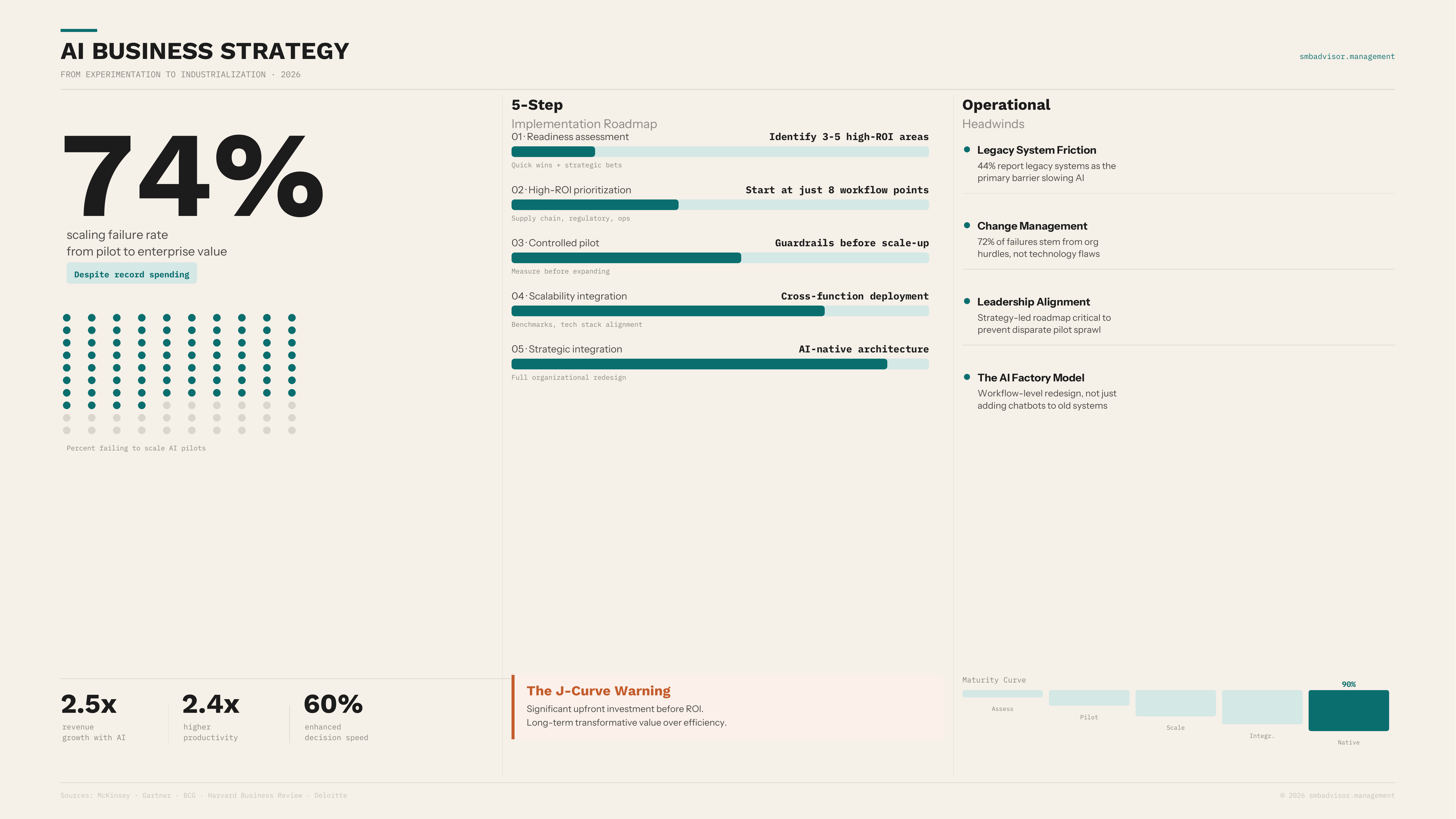
70% of AI pilots in mid-market companies fail to scale beyond the initial proof of concept, primarily due to inadequate change management, unclear ownership of AI outcomes, and insufficient integration with existing business processes. Despite record AI spending, 74% of organizations struggle to move AI from pilot to enterprise value. Organizations with integrated AI-led processes report 2.5x higher revenue growth and 2.4x higher productivity than non-integrated peers. The gap between experimenters and industrializers is widening, not narrowing.
The 5-Step Implementation Roadmap
Successful AI strategy follows a disciplined sequence. Start with readiness assessment identifying 3-5 high-ROI areas, then high-ROI prioritization, controlled pilot execution with guardrails, scalability integration across functions, and finally strategic integration into an AI-native architecture. Skipping steps is the primary cause of the 74% failure rate.
Operational Headwinds
Forty-four percent of respondents report legacy systems as the primary barrier slowing AI innovation. Seventy-two percent of AI failures stem from organizational change hurdles, not technology flaws. Leadership alignment on a strategy-led roadmap is critical to prevent the proliferation of disconnected pilot projects that drain budgets without delivering enterprise value.
Sources: McKinsey, Gartner, BCG, Harvard Business Review, Deloitte