AI-Driven Business

The 2026 Business Reckoning · Global Integration

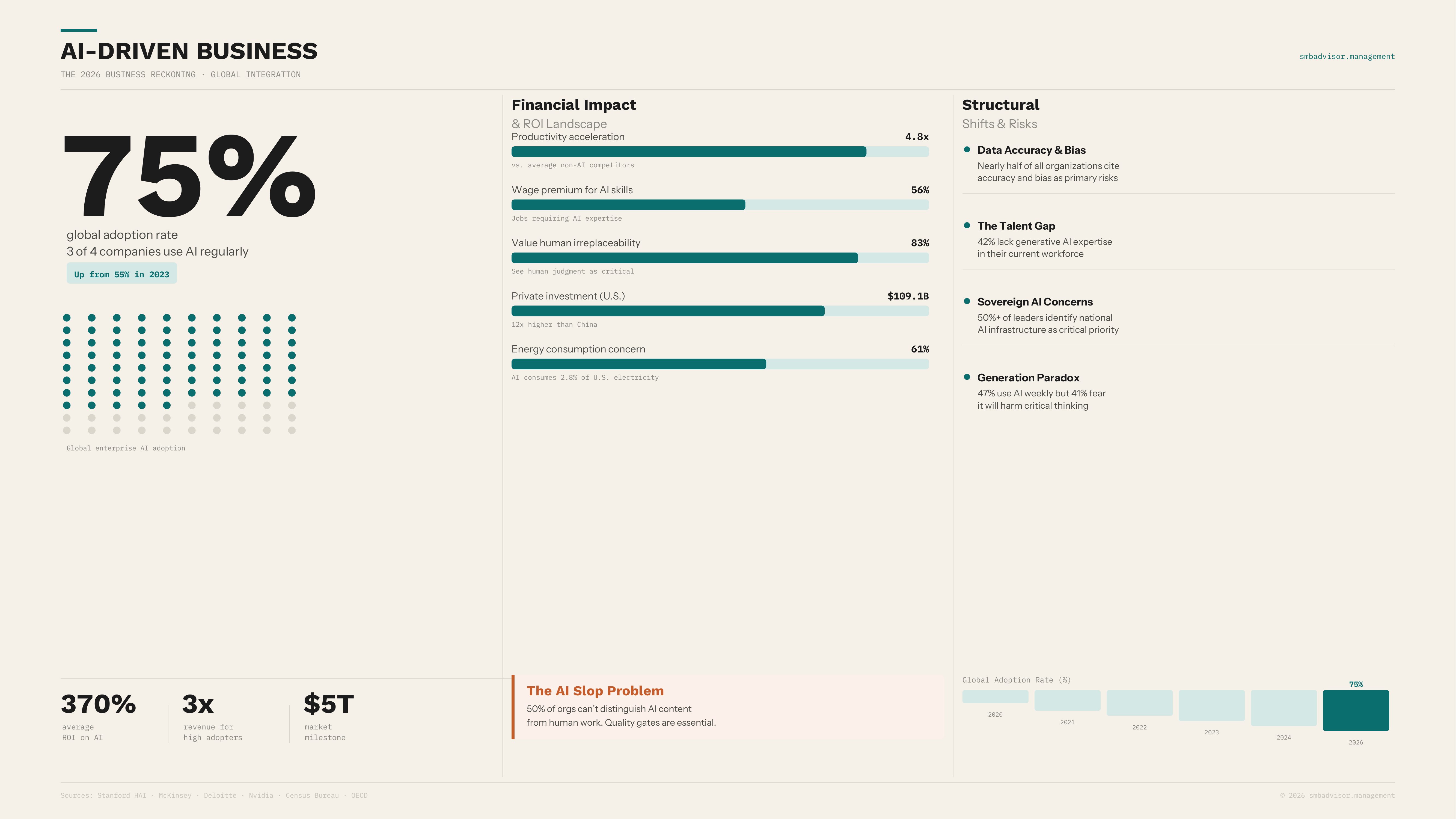
AI-Driven Business Infographic — global adoption rate with 3 of 4 companies using AI regularly
Share:

The Scale of Global Integration

AI-driven businesses differ from AI-experimenting businesses primarily in how they treat AI : operational infrastructure embedded in core processes rather than as a set of point tools applied to isolated tasks. Three out of four companies now regularly use AI for at least one function, up from 55% in 2023. U.S. private investment in AI reached $109.1 billion, nearly 12x higher than China and 3x higher than the UK. Nvidia became the first company to surpass the $5 trillion market milestone, driven by AI infrastructure demand.

Financial Impact

Organizations report an average 370% return on AI investment. Companies with high AI exposure show three times higher revenue growth. The productivity acceleration for AI-embedded industries stands at 4.8x compared to the average. Jobs requiring AI expertise command a 56% wage premium over comparable positions without AI requirements.

Structural Barriers

Nearly half of all organizations cite data accuracy and bias as their primary AI risk. Forty-two percent lack generative AI expertise in their current workforce. Sixty-one percent of Americans express concern about AI energy consumption, which now accounts for 2.8% of U.S. electricity use. The generation paradox is notable: 47% use AI weekly, but 41% fear it will harm critical thinking.

Sources: Stanford HAI, McKinsey, Deloitte, Nvidia, Census Bureau, OECD
Frequently Asked Questions

What is an AI-driven business?

An AI-driven business is one where artificial intelligence is embedded in core operational processes rather than applied as isolated tools. AI-driven companies use machine learning for decision support, automation for high-volume repeatable tasks, and AI-generated insights as standard inputs to strategy and planning.

How do I make my business AI-driven?

The path to becoming AI-driven starts with identifying the three to five highest-volume repeatable processes in your business and assessing automation potential for each. From there, build internal AI literacy before scaling, and establish governance policies for AI output review before removing human oversight from any critical process.

What competitive advantage does AI give a business?

AI-driven businesses report 3x to 5x faster decision cycles, significantly lower per-unit operational costs for automated functions, and higher customer retention rates attributable to personalization capabilities. The competitive advantage compounds over time as AI systems improve from operational data.

Share This Infographic

Copy the embed code below to share on your website with attribution.

Published by World Consulting Group. Need expert guidance on operations, strategy, or scaling your business? Get in touch.