The Stalled Pilot Crisis
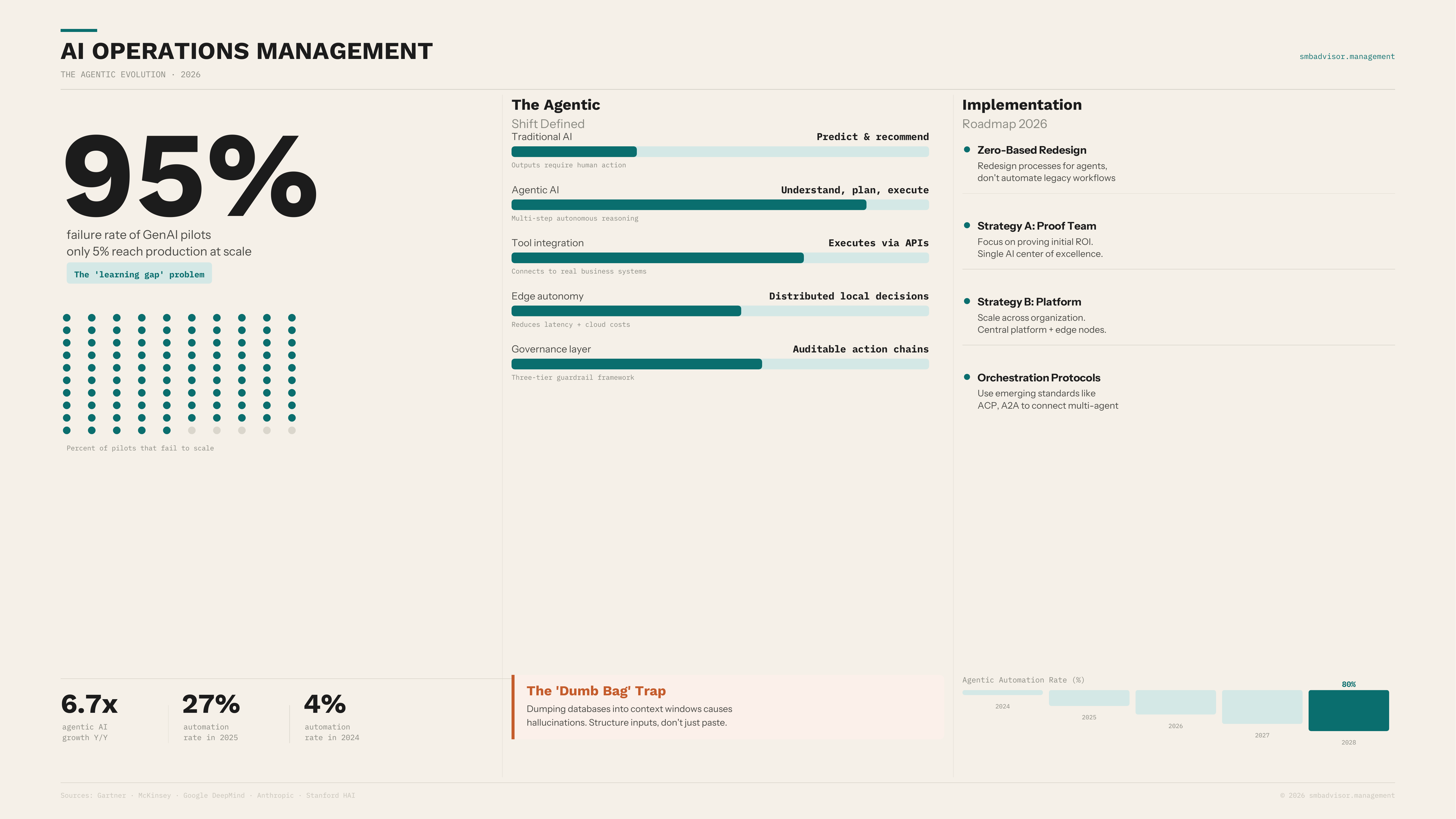
Approximately 80% of generative AI pilots fail to reach production scale in operations management contexts, with the primary failure causes being insufficient process documentation, unclear success metrics, and inadequate integration with existing operational systems. Ninety-five percent of generative AI pilots fail to reach production at scale, with only 5% achieving successful deployment. Organizations prioritizing AI report a 70% success rate, suggesting the failure lies in commitment and approach rather than technology capability. The 'learning gap' between experimentation and operational competence remains the primary barrier.
The Agentic Shift
Traditional AI predicts and recommends, requiring human action on every output. Agentic AI understands goals, plans multi-step approaches, reasons through complexity, and executes via tool integration. Agentic automation grew 6.7x year-over-year, from 4% in 2024 to 27% in 2025, outpacing documented governance frameworks.
Implementation Strategy
Zero-based process redesign is essential. Designing "agent native" processes from scratch delivers far better results than automating legacy workflows. Two strategic approaches have emerged. The proof team model focuses on a single AI center of excellence. The platform model scales AI across the organization through central infrastructure with edge deployment.
Sources: Gartner, McKinsey, Google DeepMind, Anthropic, Stanford HAI