Employers Want AI Skills They Do Not Teach
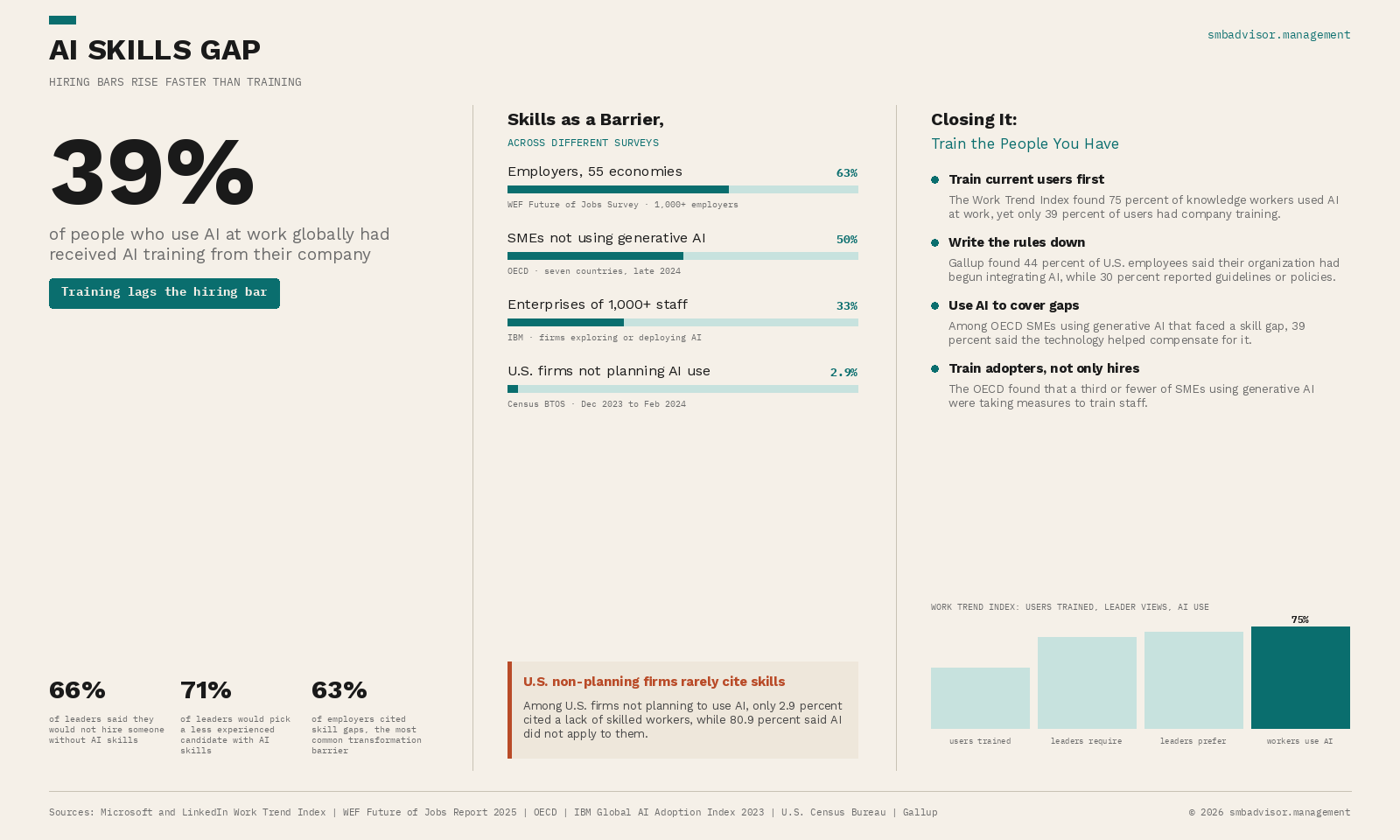
The AI skills gap is the distance between the AI skills employers expect and the skills their people have actually been trained in. In the Microsoft and LinkedIn Work Trend Index, 66% of leaders would not hire someone without AI skills. Only 39% of AI users had company training.
That survey covered 31,000 knowledge workers in 31 markets in early 2024. It also found 75% of knowledge workers used AI at work. Seventy-one percent of leaders said they would rather hire a less experienced candidate with AI skills.
How Big the Gap Looks Depends on Who Answers
Global employer surveys rank skills first. In the World Economic Forum Future of Jobs Survey of over 1,000 employers, 63% cited skill gaps, the most common barrier to transformation for 2025 to 2030. IBM found limited AI skills topped the barrier list for large enterprises at 33%.
Smaller firms abroad also cite skills, though not first. Half of the SMEs not using generative AI in the OECD survey of seven countries cited a lack of employee skills.
U.S. firms not planning AI use answer differently. In Census data from December 2023 to February 2024, only 2.9% cited a lack of skilled workers. Most, 80.9%, said AI did not apply to their business.
Closing the Gap Inside a Small Business
Training is the lever most adopting SMEs underuse. The OECD found a third or fewer of SMEs using generative AI were taking steps to train staff. Gallup found 44% of U.S. employees said their organization had begun integrating AI, but only 30% reported guidelines or formal policies.
AI can also cover part of the gap. Among OECD SMEs using generative AI that faced a skill gap, 39% said the technology helped compensate. It rose to 46% where SMEs reported better employee performance.
The practical move is to train current AI users before raising the hiring bar.
Sources: Microsoft and LinkedIn Work Trend Index, WEF Future of Jobs Report 2025, OECD, IBM Global AI Adoption Index 2023, U.S. Census Bureau, Gallup