Generative AI for Business

From Experimentation to Enterprise Value · 2025-2026

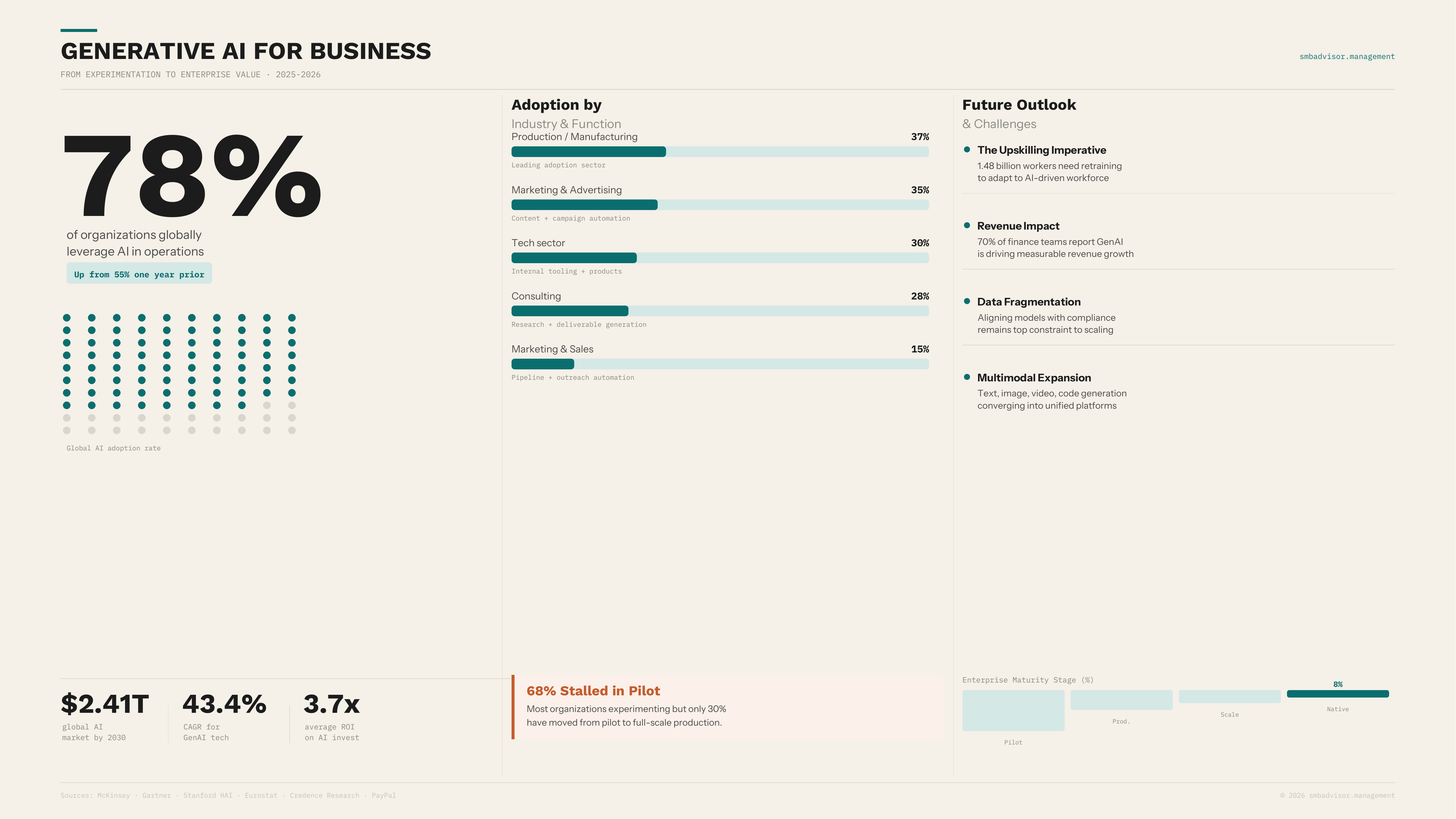
Generative AI for Business Infographic — of organizations globally now use AI in operations
Share:

Global Adoption Landscape

Generative AI is now used in operations by the majority of organizations globally, with adoption concentrated in content creation, customer service automation, and internal knowledge management functions. Seventy-eight percent of organizations globally now use AI in at least one business function, up from 55% one year prior. The global AI market is projected to reach $2.41 trillion by 2030, with generative AI specifically growing at a 43.4% compound annual rate. The average return on AI investment stands at 3.7x across industries.

Adoption by Industry

Production and manufacturing lead at 37%, followed by marketing and advertising at 35%, the technology sector at 30%, and consulting at 28%. Marketing and sales functions show the lowest adoption at 15%, suggesting significant untapped potential in pipeline automation and outreach optimization.

The Stall Problem

Sixty-eight percent of organizations remain stalled in the pilot stage. Only 30% have moved from experimentation to full-scale production. The upskilling imperative is real: 1.48 billion workers globally need retraining to adapt to AI-driven workflows. Organizations that solve the pilot-to-production gap first will capture disproportionate competitive advantage.

Sources: McKinsey, Gartner, Stanford HAI, Eurostat, Credence Research, PayPal
Frequently Asked Questions

How are businesses using generative AI?

Businesses use generative AI primarily for content creation and marketing copy, customer service automation and chatbots, internal knowledge summarization and search, code generation and developer productivity, and data analysis and reporting. Enterprise adoption is concentrated in these five functional areas.

What is the business ROI of generative AI?

Generative AI ROI varies significantly by application. Content and communication tasks show the fastest payback, typically within 30 to 60 days. Operational automation projects show higher total returns but longer payback periods of 6 to 12 months. Companies treating generative AI as infrastructure rather than a point tool report the highest long-term returns.

What are the risks of generative AI for business?

The primary risks are output accuracy and hallucination (AI generating plausible but incorrect information), data privacy when proprietary information enters AI prompts, intellectual property questions around AI-generated content, and workforce displacement without adequate change management planning.

Share This Infographic

Copy the embed code below to share on your website with attribution.

Published by World Consulting Group. Need expert guidance on operations, strategy, or scaling your business? Get in touch.