The Highest-Impact Half Hour
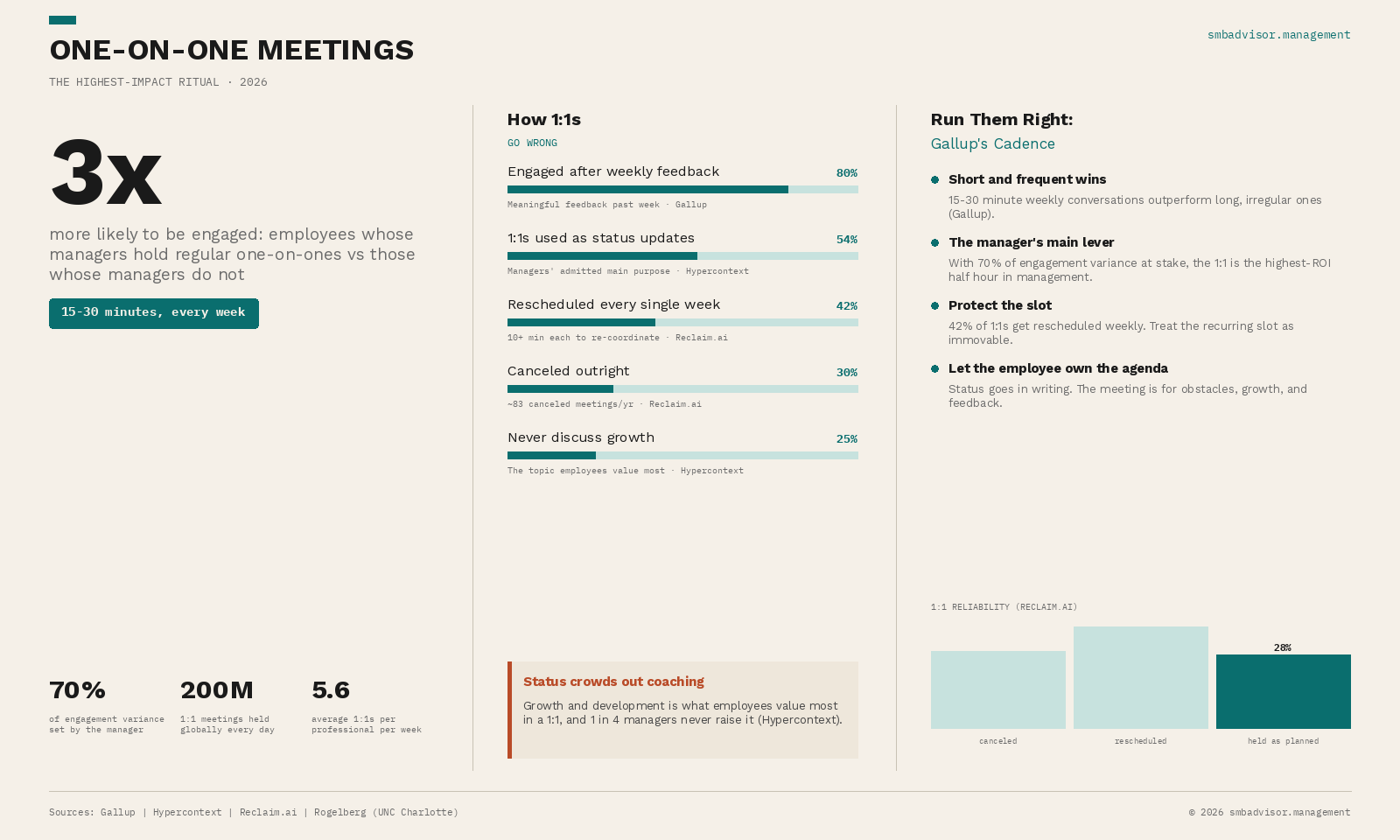
One-on-one meetings are the highest-impact management ritual measured: employees whose managers hold regular 1:1s are nearly three times as likely to be engaged, and weekly meaningful feedback correlates with 80% full engagement (Gallup). No other management habit shows a larger measured engagement effect. With the manager accounting for 70% of engagement variance, the recurring 1:1 is where that variance is actually decided. An estimated 200 million 1:1s happen globally every day (Rogelberg, UNC Charlotte).
How 1:1s Go Wrong
The format fails in predictable ways. Hypercontext's manager survey found 54% admit a main purpose of their 1:1s is just status updates, and 25% never discuss growth and development: the topic employees value most. Logistics erode the rest: Reclaim.ai's analysis of 15,000+ professionals found 42% of 1:1s get rescheduled every week and nearly 30% are canceled outright, about 83 canceled meetings per professional per year.
Run Them Right
Gallup's prescription is specific: one meaningful conversation per employee per week, 15-30 minutes, focused on goals, customers, wellbeing, not status. Move status to writing (async), let the employee own the agenda, and treat the recurring slot as immovable: a 1:1 that reschedules weekly telegraphs exactly where the employee ranks. Short and frequent beats long and rare.
Sources: Gallup, Hypercontext, Reclaim.ai, Rogelberg (UNC Charlotte)