The Listening Deficit
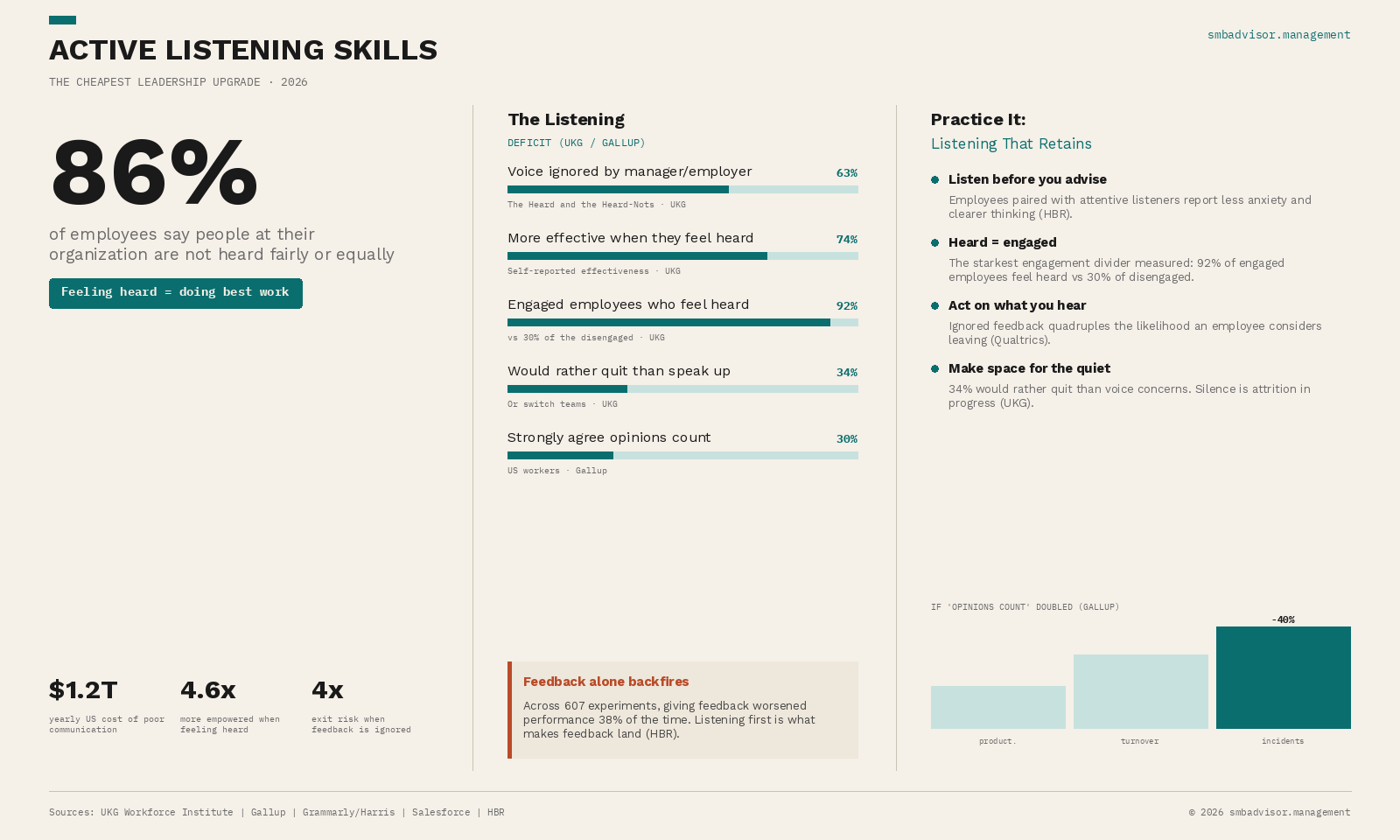
Active listening is the highest-impact communication skill in management because feeling heard is the starkest engagement divider on record: 92% of highly engaged employees feel heard at work, versus 30% of the highly disengaged. No other workplace factor splits engaged from disengaged employees so cleanly. The deficit is the norm: 86% of employees say people at their organization are not heard fairly or equally, 63% feel their own voice has been ignored, and 34% would rather quit or switch teams than voice their true concerns (UKG Workforce Institute).
What Listening Buys
The payoff is measured on both sides of the conversation. Employees who feel heard report being more effective at their jobs (74%) and are 4.6 times more likely to feel empowered to do their best work (Salesforce). Gallup's modeling goes further: doubling the share of employees who strongly agree their opinions count would cut turnover 27%, cut safety incidents 40%, and raise productivity 12%.
Listen Before You Advise
Research in Harvard Business Review explains why listening must precede feedback: across 607 experiments, giving feedback actually worsened performance 38% of the time. Listening first (attentive, non-judgmental, question-driven) reduced speakers' anxiety and improved their clarity of thought. And what you do afterward decides everything: employees whose feedback is ignored are four times more likely to consider leaving (Qualtrics).
Sources: UKG Workforce Institute, Gallup, Salesforce, Harvard Business Review, Qualtrics