What Google Found
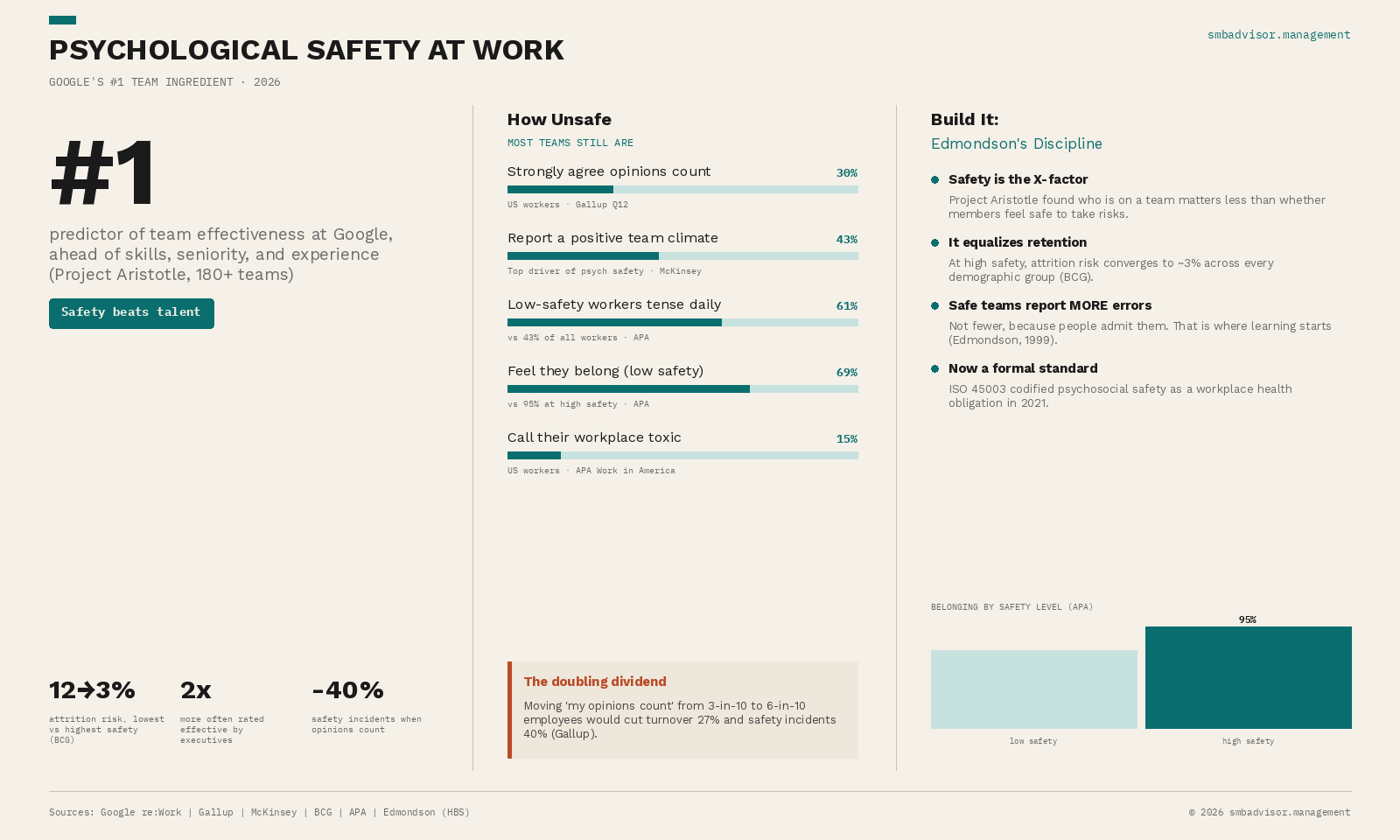
Psychological safety (a shared belief that a team is safe for interpersonal risk-taking) was the #1 predictor of team effectiveness in Google's Project Aristotle, ranking ahead of individual skills, seniority, and experience across 180+ teams. Teams that had it were rated effective twice as often. Teams high in psychological safety were rated effective twice as often by executives. The concept comes from Harvard's Amy Edmondson, whose original research found high-performing teams report more errors, not fewer, because people feel safe admitting them.
The State of Safety
Most workplaces still run a deficit. Only 3 in 10 US workers strongly agree their opinions count at work (Gallup), just 43% of employees report a positive team climate (the top driver of safety (McKinsey)) and the APA finds workers with low psychological safety are tense or stressed during the workday at 61% versus 43% overall. The belonging gap is starker still: 95% of high-safety workers say they belong at work, against 69% at low safety.
The Payoff
BCG's study of 28,000 workers in 16 countries found attrition risk falls from 12% to under 3% as psychological safety rises, and the benefit is largest for underrepresented groups, making safety a retention equalizer. Gallup adds the operational case: moving "my opinions count" from 3-in-10 to 6-in-10 employees would cut turnover 27%, cut safety incidents 40%, and raise productivity 12%. Since 2021, ISO 45003 has codified psychosocial safety as a workplace health obligation.
Sources: Google re:Work (Project Aristotle), BCG, Gallup, McKinsey, APA, Edmondson (HBS)