Confidence Runs Three Times Ahead of Preparation
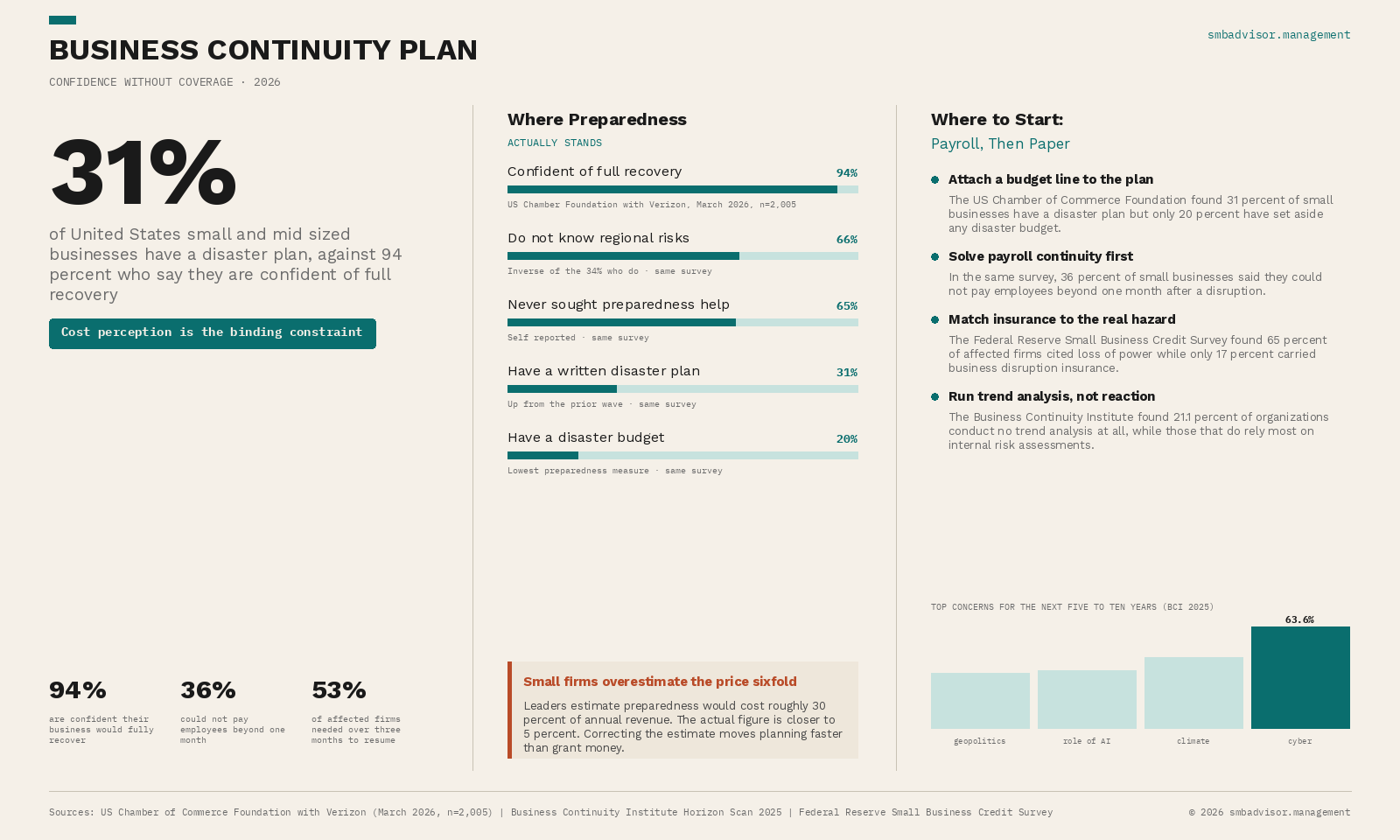
A business continuity plan documents how an organization keeps operating through a disruption. The US Chamber of Commerce Foundation surveyed 2,005 United States small and mid sized business owners in March 2026 and found 94% are confident of full recovery from a disaster, while only 31% have a plan and 20% have a disaster budget. The confidence figure is three times the preparation figure. Among firms that were actually affected, 53% needed more than three months to resume operations.
Cost Perception Is the Binding Constraint
The same survey found small business leaders estimate disaster preparedness would cost roughly 30% of annual revenue, while the actual figure is closer to 5%. That is a sixfold overestimate, and it explains more of the planning gap than budget scarcity does. 65% have never sought preparedness help and 66% do not know their regional disaster risks. Correcting the price estimate is therefore a cheaper intervention than adding grant money, because the barrier being removed is a belief rather than a cash constraint.
Payroll First, Then Paper
The most actionable finding is a cash one: 36% of small businesses said they could not pay employees beyond one month after a disruption. Payroll continuity is the first control worth testing, ahead of documentation. Insurance is the second, and it is commonly mismatched to the actual hazard. The Federal Reserve Small Business Credit Survey found 65% of affected firms cited loss of power or utilities as a source of loss while only 17% carried business disruption insurance, and 38% had flood damage while only 16% held flood coverage. On the review cadence, the Business Continuity Institute found 21.1% of organizations conduct no trend analysis at all.
Sources: US Chamber of Commerce Foundation with Verizon (March 2026, n=2,005), Business Continuity Institute Horizon Scan 2025, Federal Reserve Small Business Credit Survey