One Interruption Every Two Minutes
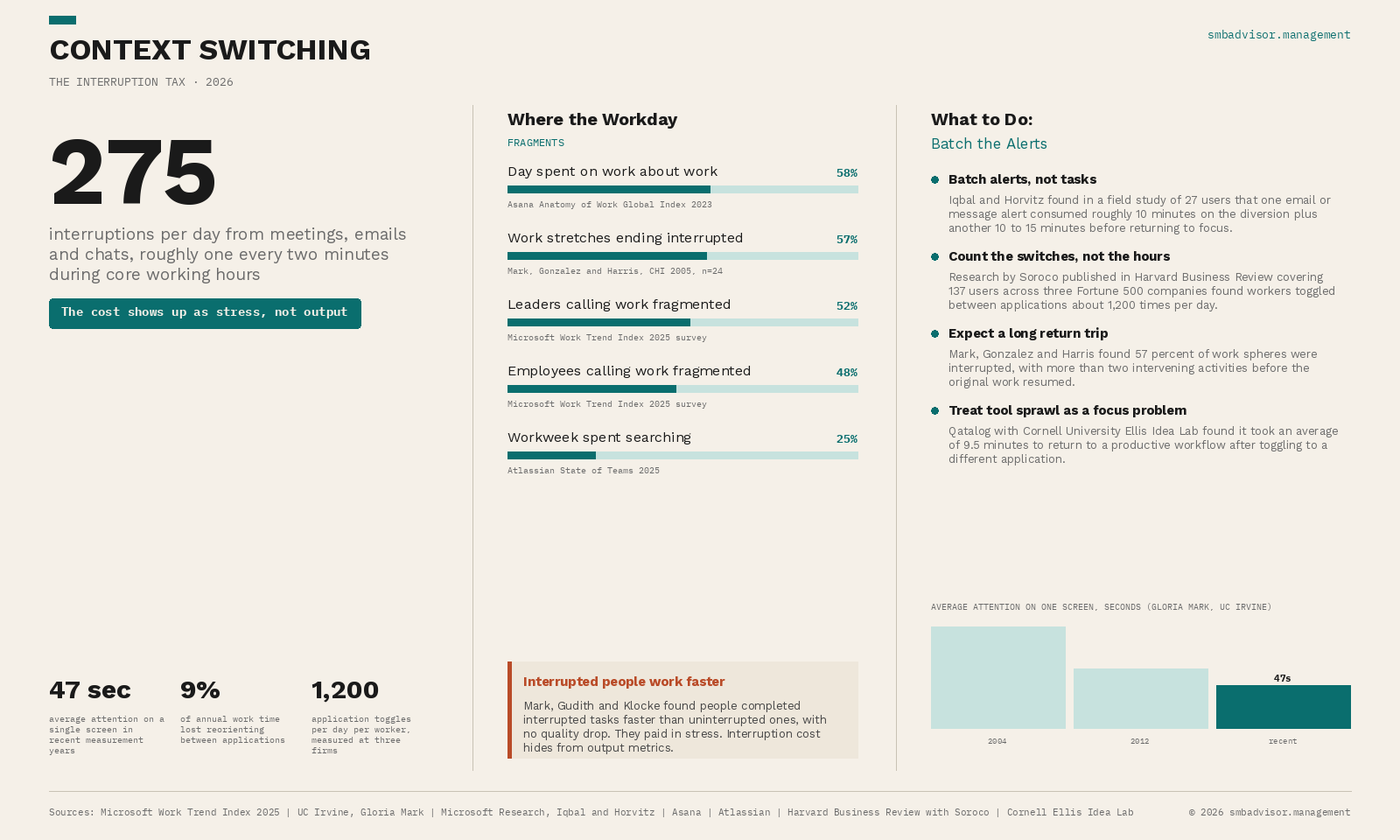
Context switching is the cost of moving attention between unrelated tasks. Microsoft telemetry for 2025 recorded 275 interruptions per day from meetings, emails and chats, roughly one every two minutes. Gloria Mark's measurements at UC Irvine show average attention on a single screen falling from about 150 seconds in 2004 to roughly 47 seconds in recent years. Microsoft's survey layer matches the telemetry: 52% of leaders and 48% of employees describe their work as fragmented.
Interrupted People Work Faster
The most important finding in this literature is the one that sounds like good news. Mark, Gudith and Klocke found participants completed interrupted tasks in less time than uninterrupted ones, with no measurable drop in quality. They paid for that speed with higher stress, frustration, time pressure and effort. This is why the interruption tax is chronically underestimated inside organizations: it does not appear in throughput, cycle time or output quality. It appears in burnout, attrition and the slow erosion of discretionary effort, none of which are attributed back to the interruption pattern that caused them.
Batch the Alerts, Count the Switches
Iqbal and Horvitz, in a field study of 27 users at Microsoft Research, found a single email or message alert consumed roughly 10 minutes on the diversion itself plus another 10 to 15 minutes before returning to focused work. Research by Soroco published in Harvard Business Review, covering 137 users across three Fortune 500 companies, found workers toggling between applications about 1,200 times per day, costing roughly 9% of annual work time. Atlassian, surveying 12,000 knowledge workers, put search time at about 25% of the workweek. Counting switches is a more honest operational metric than counting hours.
Sources: Microsoft Work Trend Index 2025, UC Irvine (Gloria Mark), Microsoft Research (Iqbal and Horvitz), Asana, Atlassian, Harvard Business Review with Soroco, Cornell Ellis Idea Lab