Management Is a Measurable Input
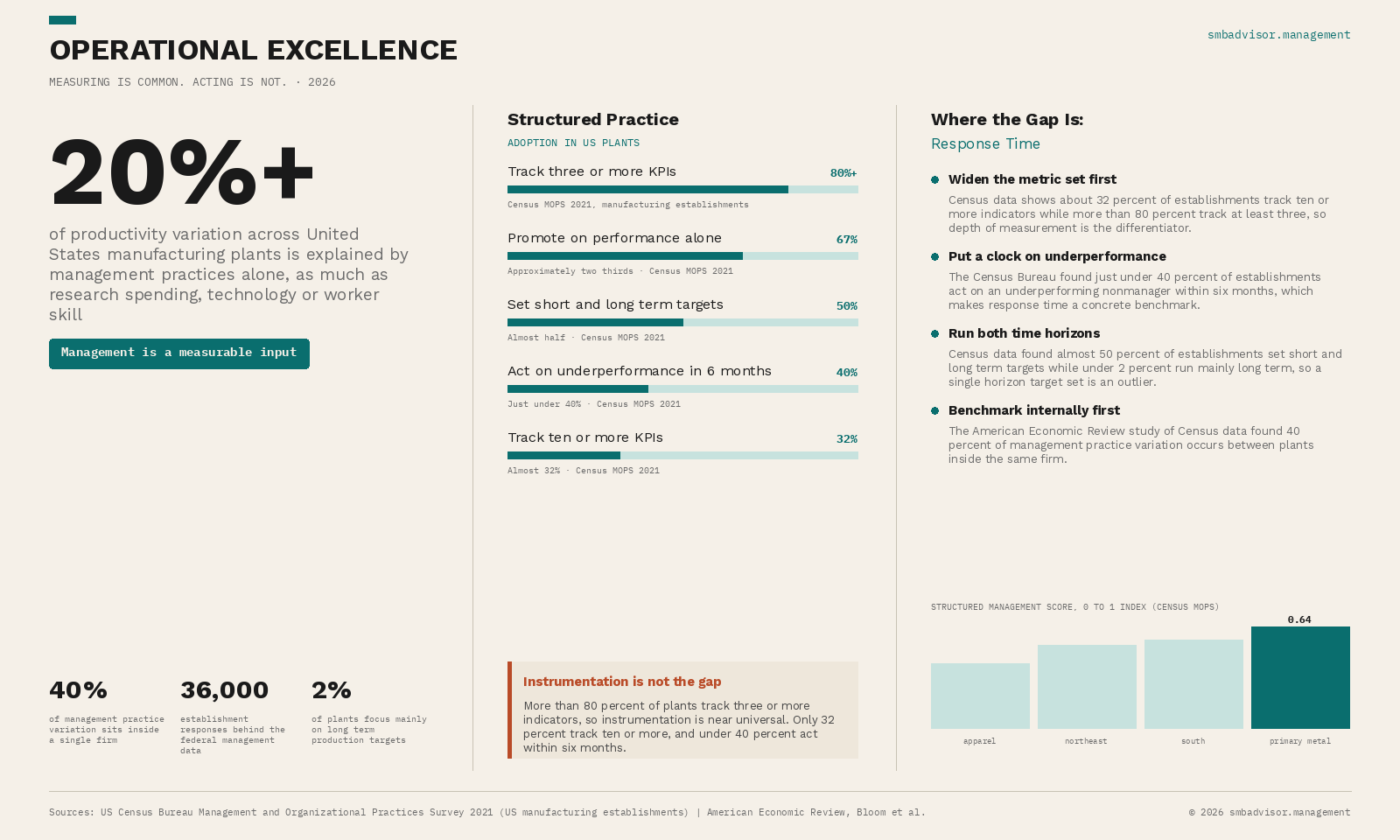
Operational excellence is often treated as a philosophy. Federal data treats it as a measurable production input. Research in the American Economic Review, using US Census Bureau data covering roughly 36,000 establishment responses, found management practices alone explain more than 20% of productivity variation across United States manufacturing plants, comparable to research spending or worker skill. The same work found 40% of management practice variation occurs between plants inside the same firm, which means the nearest useful benchmark is usually internal.
The Gap Is Response Time, Not Instrumentation
The Census Management and Organizational Practices Survey shows measurement is close to universal. More than 80% of establishments track three or more key performance indicators. Depth is where the distribution thins: only about 32% track ten or more. Action thins further. Just under 40% act on an underperforming nonmanager within six months, and approximately two thirds promote on performance alone. The binding constraint is not data availability. It is the interval between observing underperformance and doing something about it, which makes response time a concrete and benchmarkable target.
Run Both Time Horizons
Census data found almost 50% of establishments set both short and long term production targets, while under 2% focus mainly on long term targets. A single horizon target set is therefore an outlier in both directions, and the long horizon only variant is rare enough to be treated as a warning sign rather than a strategy. Structured management scores vary widely by industry and region, from roughly 0.37 in apparel to 0.64 in primary metal on the survey's 0 to 1 index, so cross industry comparison is far less informative than comparison against plants inside the same firm.
Sources: US Census Bureau Management and Organizational Practices Survey 2021 (US manufacturing establishments), American Economic Review (Bloom et al.)