Ownership Is the Variable
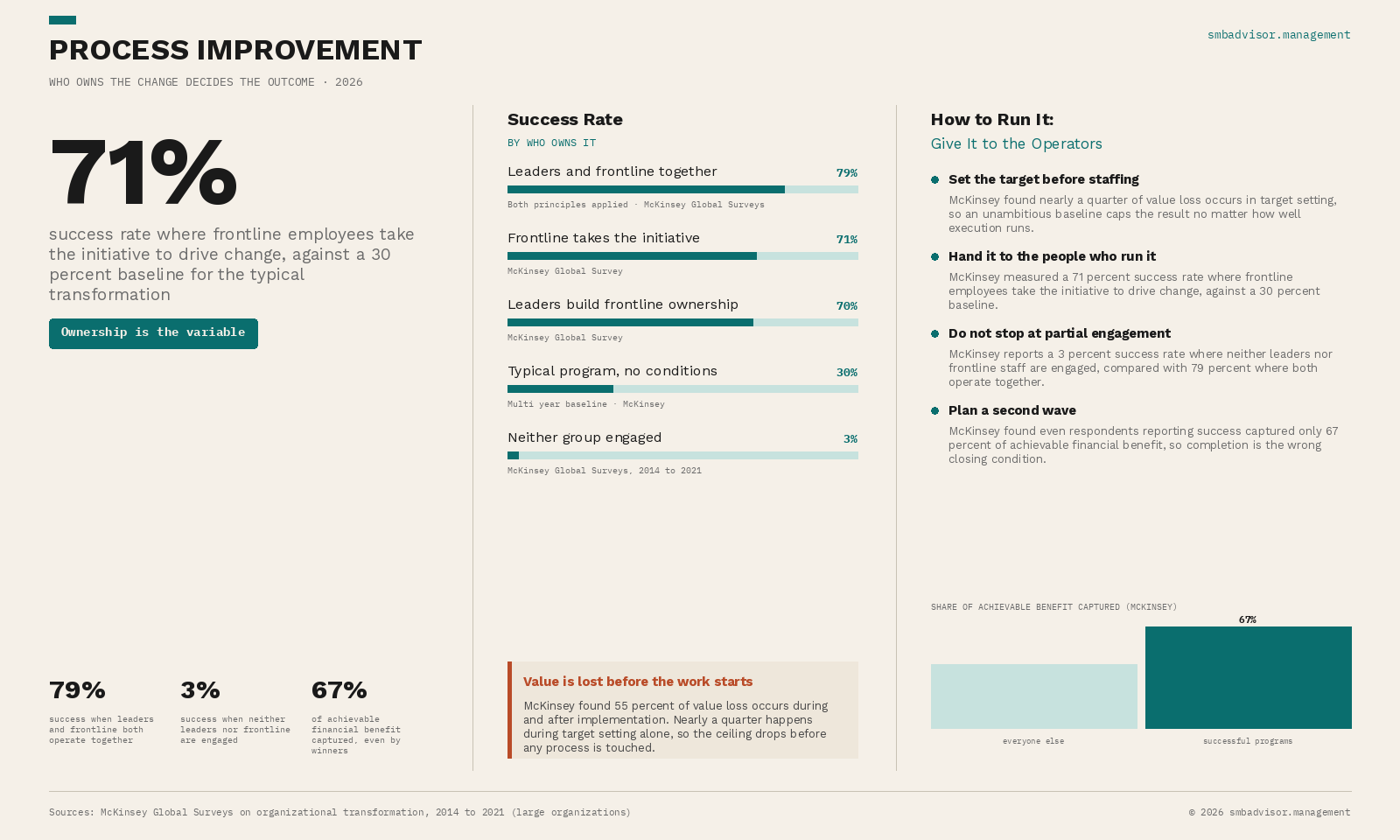
Process improvement succeeds or fails on who owns the change. Across McKinsey Global Surveys from 2014 to 2021, the typical program succeeded 30% of the time. Where frontline employees took the initiative, success reached 71%. Where leaders and frontline operated together, it reached 79%. Where neither was engaged, success fell to 3%. That is a spread of more than twenty five to one, driven by a variable most improvement programs treat as a communications afterthought rather than a design decision.
Partial Engagement Is Close to No Engagement
The distribution is not linear, which is the practically important part. Leaders building frontline ownership reaches 70% and frontline taking initiative reaches 71%, both close to the 79% ceiling. But the 3% floor for no engagement sits far below the 30% baseline for a program run without any deliberate ownership condition at all. Engagement is not a modifier applied to a program. It is closer to a precondition, and a program that secures it partially performs much nearer the bottom of the range than the middle.
Set the Target Before Staffing the Team
McKinsey attributes nearly a quarter of all transformation value loss to the target setting phase, and 55% to the period during and after implementation. The target setting share is the one worth acting on first, because it happens before any process is touched and it caps everything downstream. Completion is also the wrong closing condition. Even respondents who reported success captured only 67% of the achievable financial benefit, against 37% for everyone else, which means a second wave is normal rather than a sign the first wave failed. These samples are large organizations.
Sources: McKinsey Global Surveys on organizational transformation, 2014 to 2021 (large organizations)