What Time Management Actually Improves
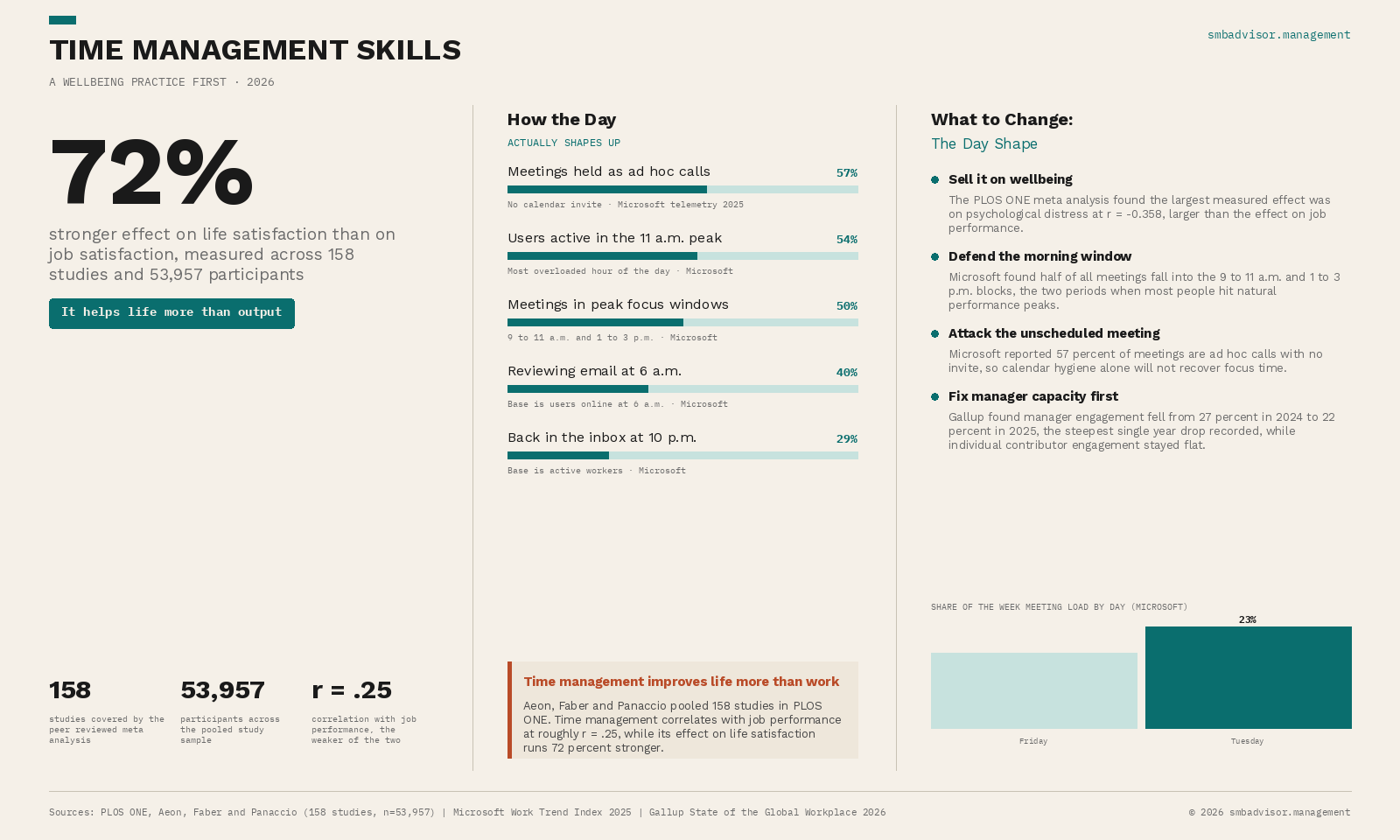
Time management is usually sold as a performance practice. The evidence points elsewhere. A peer reviewed meta analysis by Aeon, Faber and Panaccio in PLOS ONE, pooling 158 studies and 53,957 participants, found time management correlates with job performance at roughly r = .25, while its effect on life satisfaction runs 72% stronger than its effect on job satisfaction. The single largest relationship in the analysis was the reduction of psychological distress at r = -0.358, larger than the performance effect. Time management is a wellbeing practice that happens to help output, not the reverse.
The Shape of the Day
Microsoft telemetry for 2025 describes where the time goes. 57% of meetings are ad hoc calls with no calendar invite. 54% of users are active in the 11 a.m. peak, the most overloaded hour of the day. Half of all meetings fall inside the 9 to 11 a.m. and 1 to 3 p.m. windows. At the edges, 40% of those online at 6 a.m. are reviewing email and 29% of active workers are back in the inbox by 10 p.m. Tuesday carries 23% of the week's meeting load against Friday at 16%.
Fix Manager Capacity Before Individual Habits
Individual technique has a ceiling when the surrounding system is saturated. Gallup found manager engagement fell from 27% in 2024 to 22% in 2025, the steepest single year drop recorded, while individual contributor engagement stayed roughly flat. Managers set meeting load, deadline realism and interruption norms for everyone beneath them, so a manager operating without capacity generates time pressure that no subordinate technique can absorb. Sequence accordingly: protect the morning window at the team level, attack the unscheduled meeting, and treat personal technique as the last layer.
Sources: PLOS ONE (Aeon, Faber and Panaccio, 158 studies, n=53,957), Microsoft Work Trend Index 2025, Gallup State of the Global Workplace 2026