Where Stress Actually Concentrates
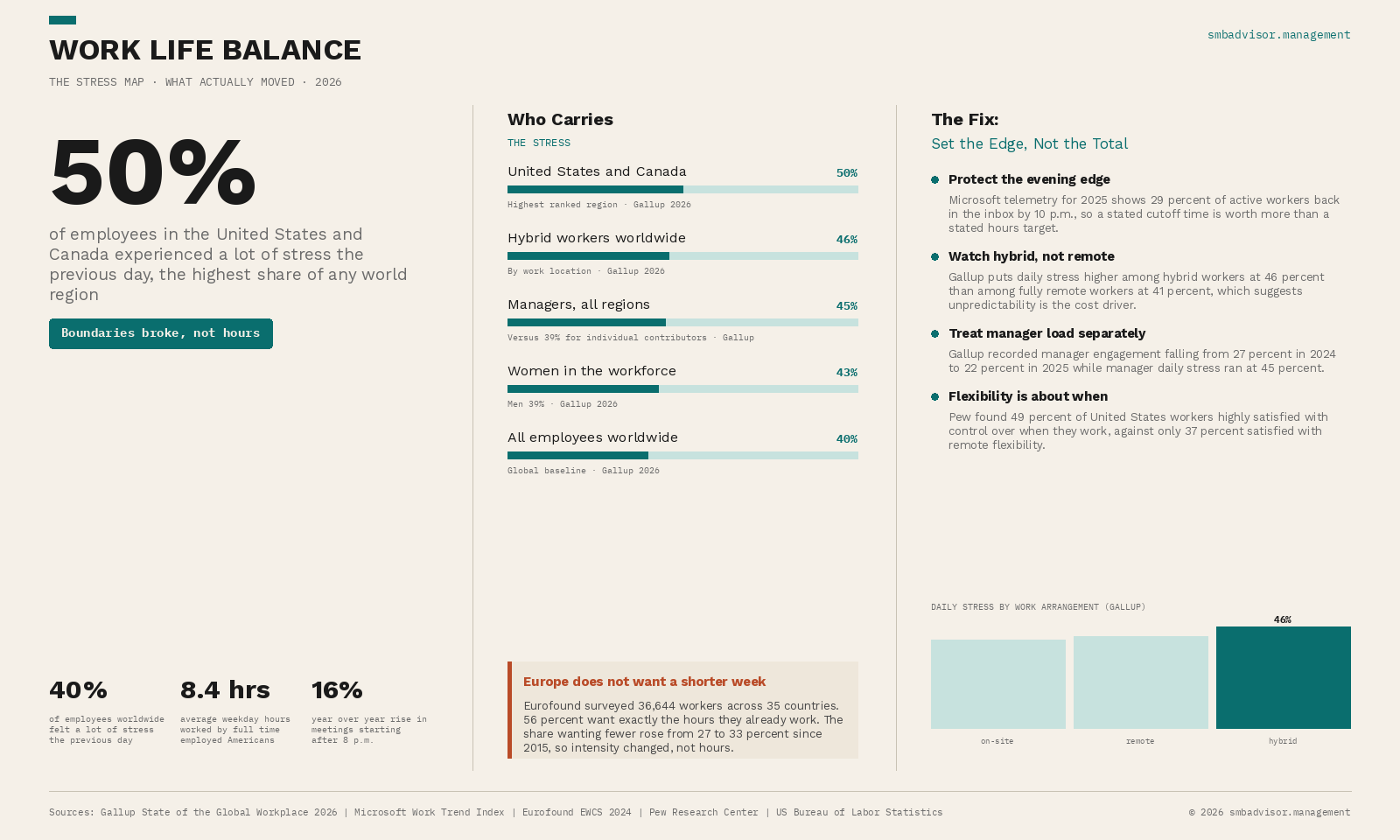
Work life balance is not primarily a question of how many hours are worked. Gallup found 50% of employees in the United States and Canada experienced a lot of stress the previous day, the highest share of any world region, while average weekday hours for full time employed Americans sit at 8.4 according to the Bureau of Labor Statistics. Hours have stayed roughly flat. Stress has not. The pressure shows up at the boundaries of the day rather than in its total length.
Hybrid Costs More Than Remote
The counterintuitive finding is that hybrid arrangements report higher daily stress than fully remote ones. Gallup puts hybrid workers at 46% and fully remote workers at 41%. Unpredictability appears to be the driver rather than location itself, because a schedule that changes week to week removes the ability to plan around it. Managers carry more than their teams, reporting 45% daily stress against 39% for individual contributors, and manager engagement fell from 27% in 2024 to 22% in 2025, the steepest single year drop Gallup has recorded.
Set the Edge, Not the Total
Eurofound surveyed 36,644 workers across 35 countries and found 56% want exactly the hours they already work. The share preferring fewer rose from 27% to 33% since 2015, which points at intensity rather than volume. The practical lever is the edge of the day. Microsoft telemetry for 2025 shows 29% of active workers back in the inbox by 10 p.m. and a 16% year over year rise in meetings starting after 8 p.m. Pew found 49% of United States workers highly satisfied with control over when they work, against 37% satisfied with remote flexibility.
Sources: Gallup State of the Global Workplace 2026, Eurofound EWCS 2024, Microsoft Work Trend Index, Pew Research Center, US Bureau of Labor Statistics