The Number Everyone Cites Was a Guess
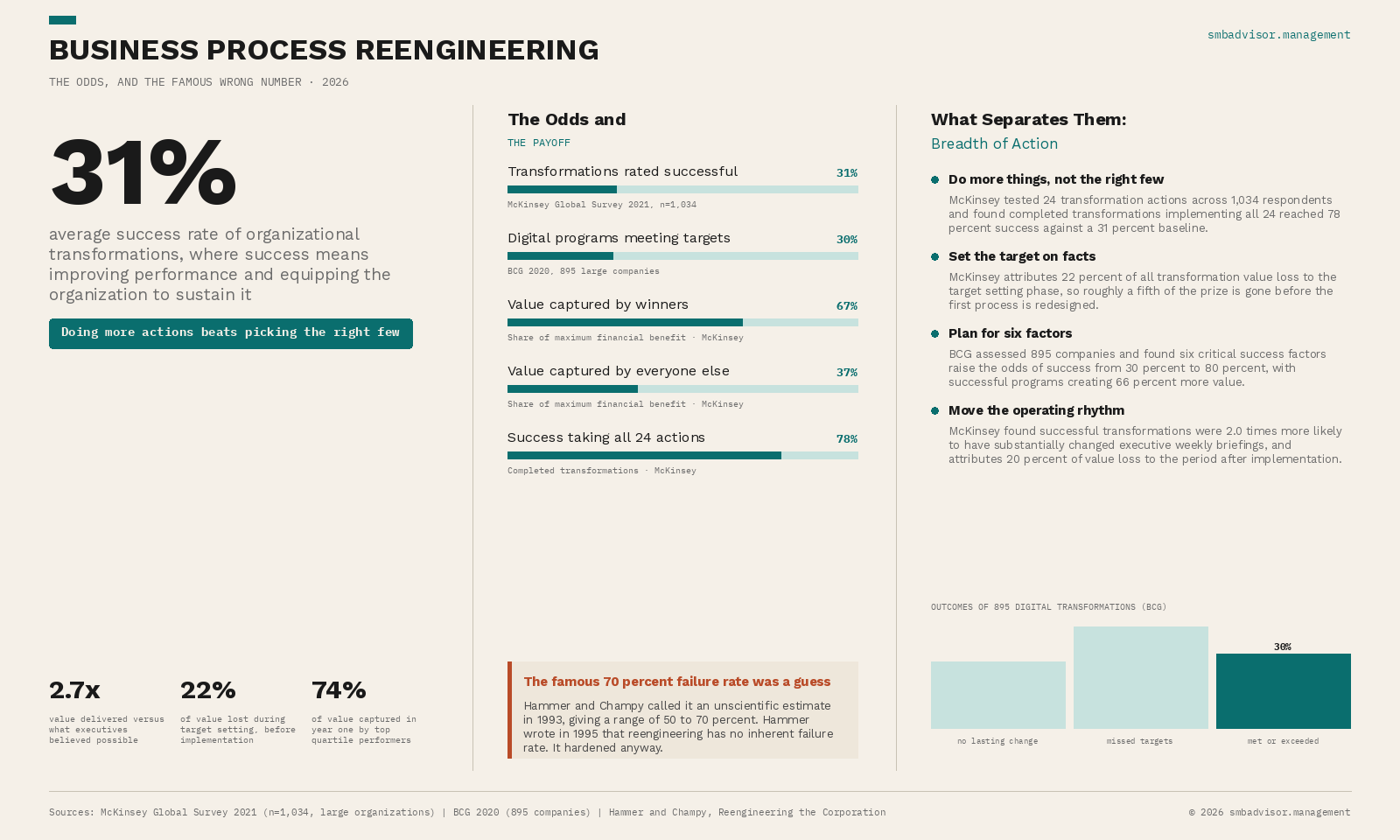
Business process reengineering is the fundamental redesign of processes to achieve step change improvement rather than incremental gain. The claim that 70% of such efforts fail traces to Hammer and Champy, who called it an unscientific estimate in 1993 and gave a range of 50% to 70%. Hammer wrote in 1995 that reengineering has no inherent failure rate. The figure hardened into fact anyway. Measured rates from McKinsey and BCG land in a similar neighborhood, but they measure different things, so the coincidence should not be read as confirmation.
What the Measured Rates Say
McKinsey's 2021 Global Survey of 1,034 respondents put average transformation success at 31%, where success means both improving performance and equipping the organization to sustain it. BCG assessed 895 large companies and found 30% of digital programs met or exceeded targets, 44% created some value but missed targets, and 26% produced no lasting change. Even among the winners, value capture is partial: successful programs captured 67% of the maximum achievable financial benefit against 37% for everyone else. Note the samples throughout are large organizations, not small businesses.
Breadth of Action Beats Choosing Well
The most useful finding is counterintuitive. McKinsey tested 24 distinct transformation actions and found completed transformations that implemented all 24 reached 78% success against the 31% baseline. There is no small set of decisive actions that substitutes for the rest. BCG reached a compatible conclusion, finding six critical success factors that raise the odds from 30% to 80%, with successful programs creating 66% more value. Where value leaks is equally specific: McKinsey attributes 22% of total value loss to the target setting phase, before a single process is redesigned.
Sources: McKinsey Global Survey 2021 (n=1,034, large organizations), BCG 2020 (895 companies), Hammer and Champy, Reengineering the Corporation