The Capacity Problem Is Not a Motivation Problem
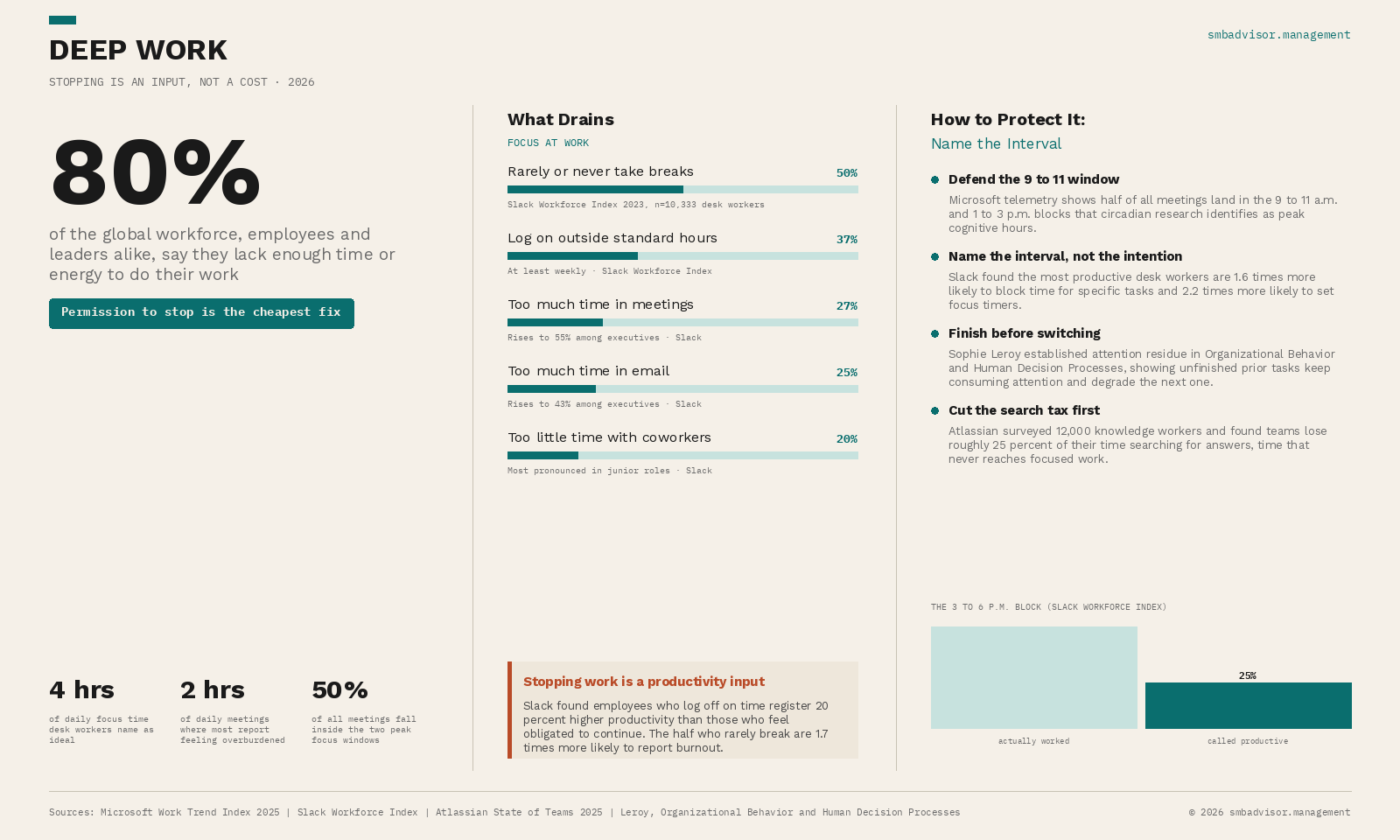
Deep work is sustained cognitive effort on a single demanding task without switching. Microsoft found 80% of the global workforce say they lack enough time or energy to do their work, and half of all meetings fall inside the 9 to 11 a.m. and 1 to 3 p.m. blocks that research identifies as peak cognitive hours. Desk workers name about four hours of daily focus time as ideal and report feeling overburdened past roughly two hours of daily meetings. The gap between those two numbers is the whole problem.
Stopping Raises Measured Output
Slack's Workforce Index surveyed 10,333 desk workers and found half rarely or never take breaks during the workday. Those who do take regular breaks score 13% higher on productivity, and employees who log off at the end of the standard day register 20% higher productivity than those who feel obligated to continue. The half who rarely break are 1.7 times more likely to report burnout. Stopping behaves like an input to output rather than a subtraction from it.
Name the Interval
The most productive desk workers in Slack's data are 1.6 times more likely to block time for specific tasks and 2.2 times more likely to set focus timers. Intent alone does not survive contact with a calendar. Sophie Leroy's attention residue research, published in Organizational Behavior and Human Decision Processes, shows unfinished prior tasks keep consuming attention and degrade performance on the next one, which is an argument for finishing a unit of work rather than time boxing and abandoning it. Atlassian surveyed 12,000 knowledge workers and found teams lose roughly 25% of their time searching for answers, time that never reaches focused work at all.
Sources: Microsoft Work Trend Index 2025, Slack Workforce Index, Atlassian State of Teams 2025, Leroy in Organizational Behavior and Human Decision Processes