The Most Basic Expectation Is the One That Broke
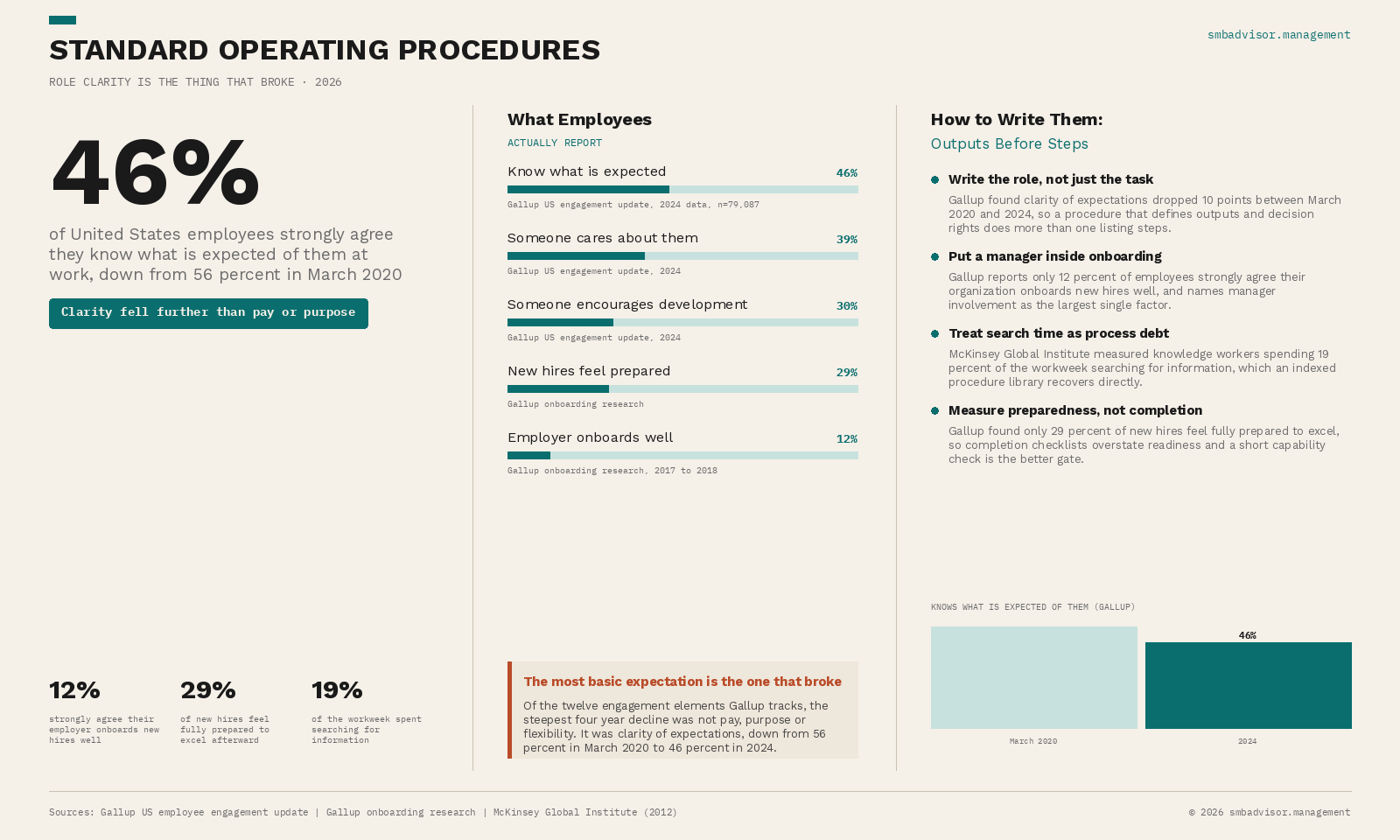
A standard operating procedure exists to make expected performance unambiguous. Gallup found only 46% of United States employees strongly agree they know what is expected of them at work, down from 56% in March 2020, and of the twelve engagement elements Gallup tracks, clarity of expectations showed the steepest four year decline. It fell further than pay, purpose or flexibility. That ordering matters, because clarity is the element most directly addressable by documentation, and it is the one that deteriorated most.
Onboarding Is Where Procedures Fail First
Gallup reports only 12% of employees strongly agree their organization onboards new hires well, and only 29% of new hires feel fully prepared to excel after onboarding. The measure that matters is preparedness, not completion. A checklist that records which documents were read overstates readiness, because it captures exposure rather than capability. Gallup names manager involvement as the largest single factor in onboarding effectiveness, which means a procedure library without a manager attached to it is an artifact rather than a system.
Write Outputs Before Steps
The decline in clarity is a decline in understood outputs and decision rights, not in documented steps. A procedure that lists actions without naming the result, the owner and the decision authority leaves the expectation gap intact. There is also a direct retrieval cost: McKinsey Global Institute measured knowledge workers spending 19% of the workweek searching for information, which an indexed and maintained procedure library recovers directly. Write the output first, the decision rights second, and the steps last.
Sources: Gallup US employee engagement update, Gallup onboarding research, McKinsey Global Institute (2012)