Operator Error Is Never the Root Cause
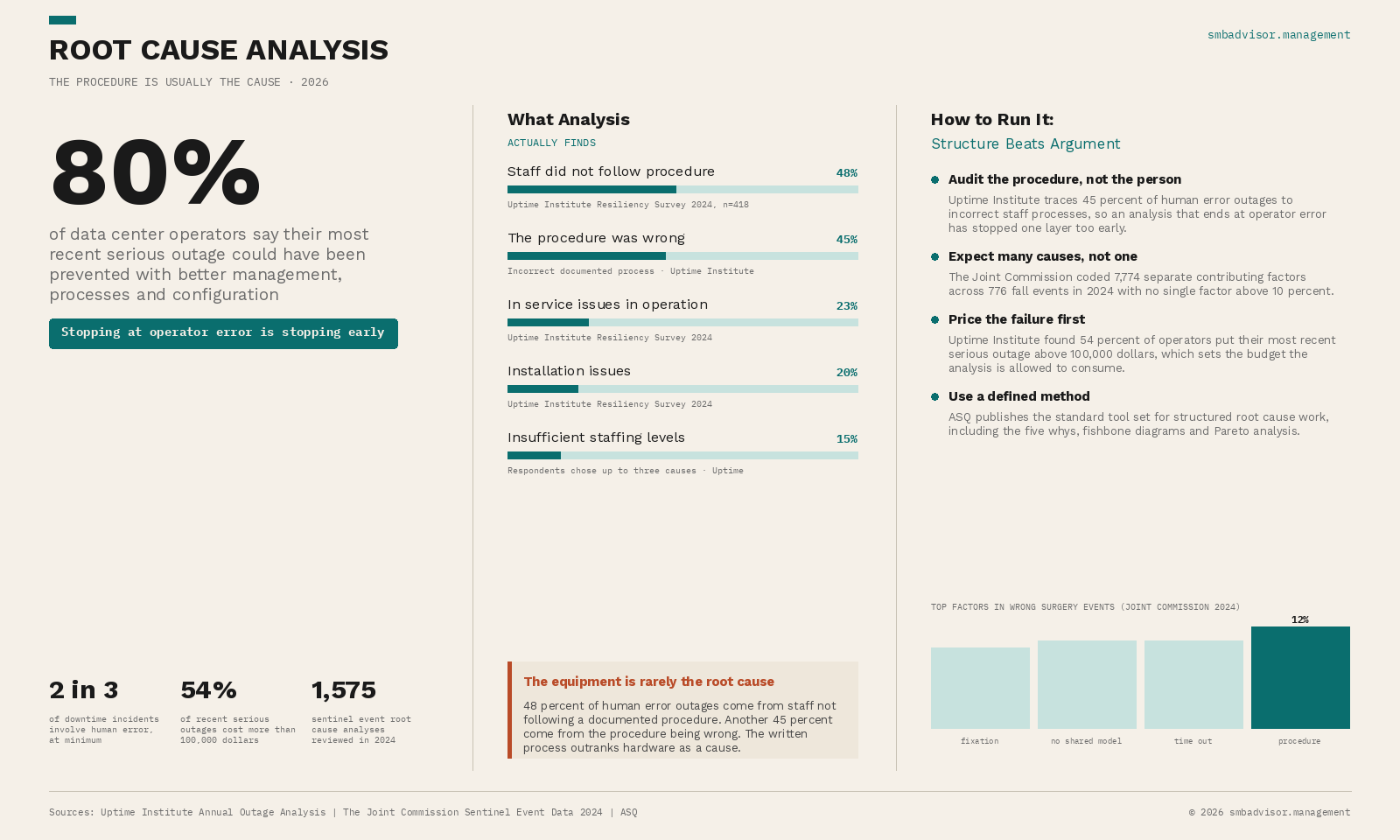
Root cause analysis is the structured practice of tracing a failure past its immediate trigger to the conditions that allowed it. The Uptime Institute found 80% of operators say their most recent serious outage could have been prevented with better management, processes and configuration, which means the majority of serious failures are process failures rather than equipment failures. Human error contributes to somewhere between two thirds and 80% of downtime incidents. That statistic is often read as a case for better staff. The underlying data says otherwise.
What the Analysis Actually Finds
When the Uptime Institute asked 418 operators to identify the causes behind human error outages, 48% pointed to staff not following a documented procedure and 45% pointed to the documented procedure itself being incorrect. Respondents could select up to three causes, so these overlap rather than sum. The pattern still holds: the written process is implicated more often than any piece of hardware. An analysis that concludes with operator error has stopped at the trigger and never reached the condition, which guarantees the same failure recurs under a different name.
Expect Many Causes, Not One
Single cause explanations are usually artifacts of stopping early. The Joint Commission reviewed 1,575 sentinel event root cause analyses in 2024 and coded 7,774 separate contributing factors across 776 fall events alone, with no single factor exceeding 10%. Real failures are multi causal. The practical constraint is budget, and the Uptime Institute supplies it: 54% of operators put their most recent serious outage above 100,000 dollars, which sets the ceiling on what the analysis is worth. ASQ publishes the standard tool set, including the five whys, fishbone diagrams and Pareto analysis.
Sources: Uptime Institute Annual Outage Analysis, The Joint Commission Sentinel Event Data 2024, ASQ