What the Matrix Actually Sorts
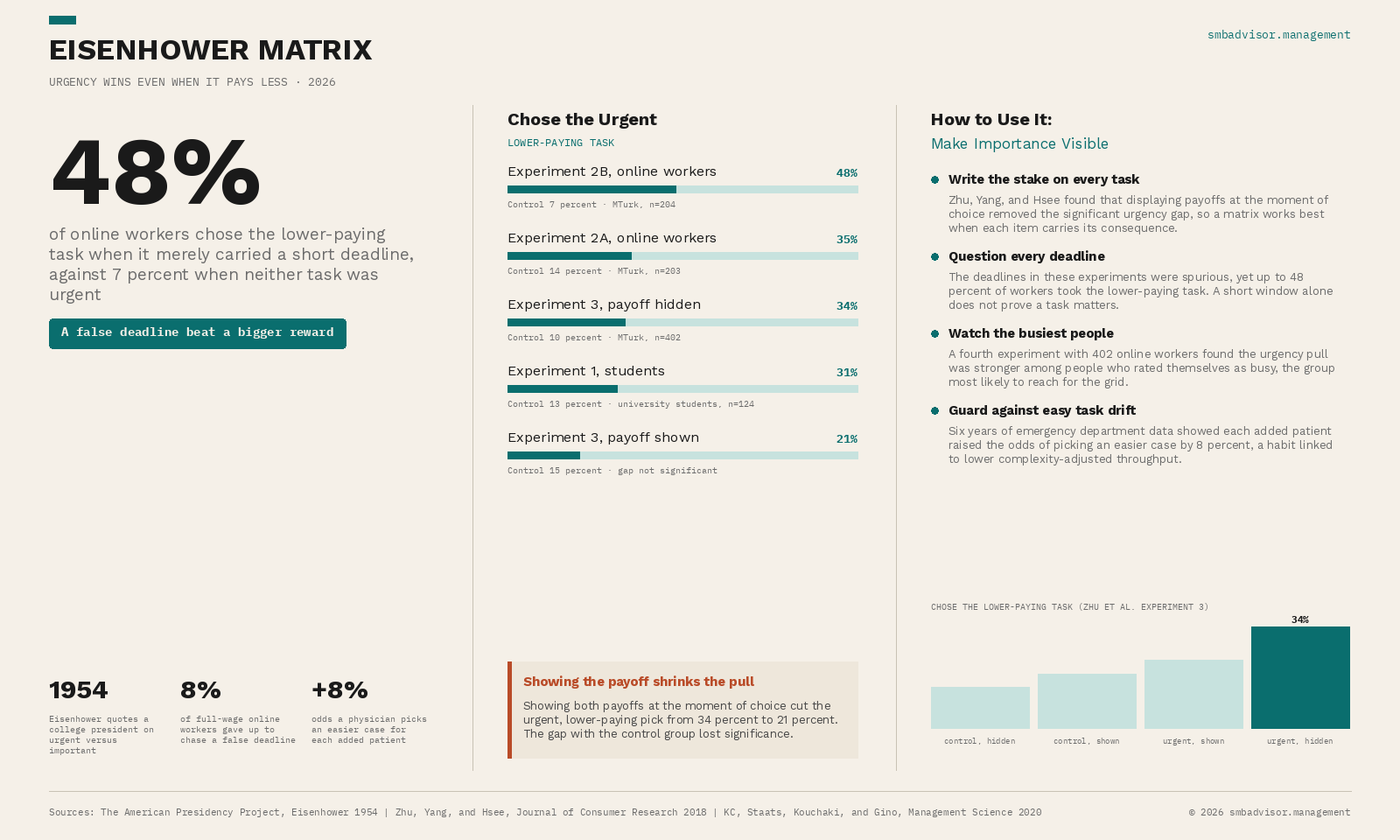
The Eisenhower Matrix is a two-by-two grid that sorts tasks by urgency and importance, then protects important work from merely urgent work. In controlled experiments, 48% of online workers chose a lower-paying task when it simply carried a short deadline, against 7% when neither task was urgent.
The name traces to a speech Dwight Eisenhower gave in Evanston, Illinois, in August 1954. He quoted a former college president who said the urgent problems were not important and the important problems were never urgent. The speech offers the distinction. It contains no grid.
Urgency Pulls Attention Off the Payoff
Zhu, Yang, and Hsee tested this pull in five experiments published in the Journal of Consumer Research in 2018. Participants were university students and Amazon Mechanical Turk workers, not small-business staff. Each design made one task objectively more rewarding, yet a false expiry window shifted choices toward the smaller reward.
In one study, online workers gave up the equivalent of 8% of their full wage to chase a deadline. Measured attention moved toward the expiry time and away from the bonus amount. The effect grew stronger among people who described themselves as busy.
Make the Payoff Visible
The same research points to the fix. When the researchers showed both payoffs at the moment of choice, the urgent low-paying pick fell from 34% to 21%. The gap with the control group also lost statistical significance.
Field data shows a related drift. KC, Staats, Kouchaki, and Gino analyzed six years of emergency department records. They found each added patient raised the odds of a physician choosing an easier case by 8%.
In their online replication, 76% picked the easy task under high workload against 64% under low workload. A matrix helps only when every task carries its stake in writing.
Sources: The American Presidency Project, Journal of Consumer Research 2018, Management Science 2020