Specific and Hard Beats Vague and Easy
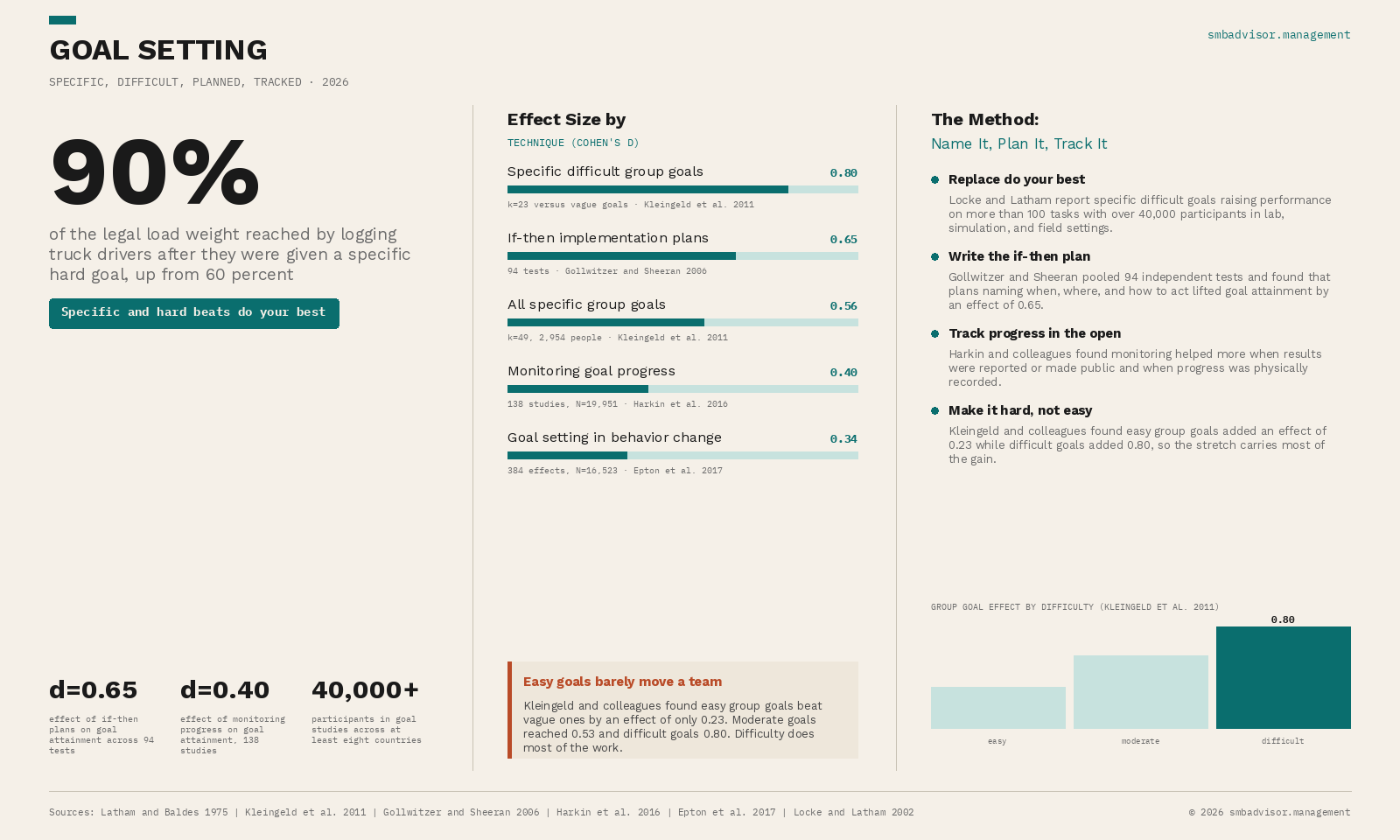
Goal setting is the practice of fixing a specific, measurable target for a person or team before the work starts. A Journal of Applied Psychology meta-analysis pooled 49 effect sizes. Specific group goals raised group performance by d = 0.56 over vague goals, and specific difficult goals raised it by d = 0.80.
Easy goals added only 0.23. The studies covered 739 groups in lab and field settings. They did not target small firms, but the direction is consistent.
Checkable Targets Change Behavior
A goal only works when someone can check progress against it. Locke and Latham cite a field study of logging truck drivers. Given a specific hard goal, the drivers raised loads from 60% to 90% of the legal weight limit.
The two authors trace goal effects across more than 100 tasks and over 40,000 participants in at least eight countries. The common thread is a target specific enough to make progress checkable.
Plans and Tracking Close the Gap
Two habits turn a goal into action. Gollwitzer and Sheeran pooled 94 tests of if-then plans, which name when, where, and how to act. These plans lifted attainment by d = 0.65.
Harkin and colleagues reviewed 138 experiments with 19,951 participants and found progress monitoring raised attainment by d = 0.40. Monitoring worked better when people shared results and recorded them physically. Most of these studies tracked health goals, so the workplace transfer is an inference.
Sources: Latham and Baldes 1975, Kleingeld, van Mierlo, and Arends 2011, Gollwitzer and Sheeran 2006, Harkin et al. 2016, Epton, Currie, and Armitage 2017, Locke and Latham 2002