A Quarterly Goal System From Intel
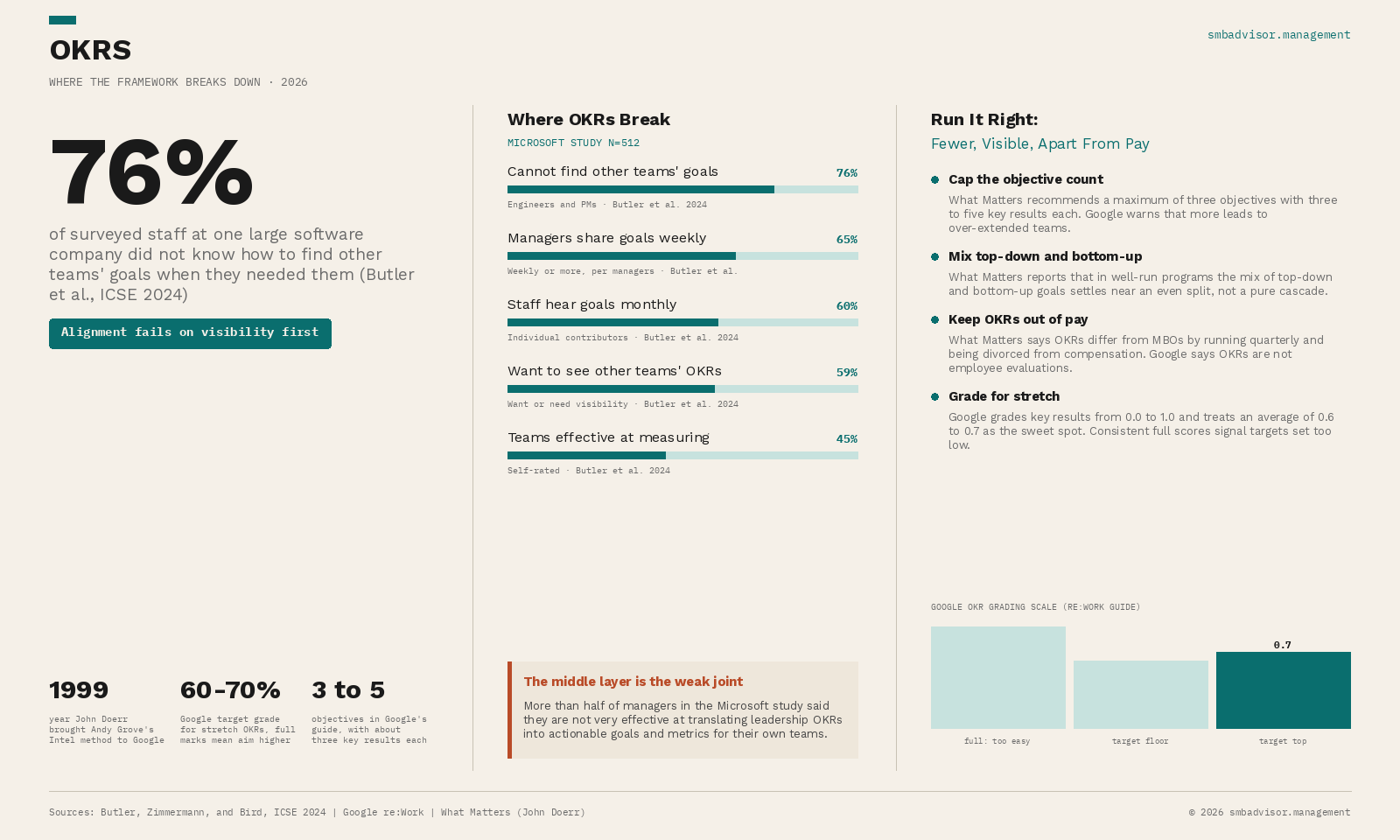
OKRs, or objectives and key results, are a goal framework that pairs a qualitative objective with a few measurable results, set quarterly and published openly. Andy Grove built the method at Intel from Peter Drucker's 1950s management by objectives, and John Doerr introduced it to Google's founders in 1999.
Doerr's own site states that OKRs differ from MBOs in two ways. They run quarterly rather than annually, and they stay divorced from compensation.
Where Programs Break Down
Microsoft researchers Butler, Zimmermann, and Bird studied one large software company after it adopted OKRs. They ran 47 interviews and received 512 survey responses from a population of more than 4,000 engineers. In the survey, 76% did not know how to find other teams' goals when needed, and 59% wanted to see them.
More than half of managers said they were not very effective at translating leadership OKRs into team goals. Only 45% of teams rated themselves effective at measuring goals. The sample is one enterprise, not a small business.
Fewer Objectives, Honest Grades
Google's re:Work guide recommends three to five objectives with about three key results each, warning that more leads to a diffusion of effort. Doerr's What Matters goes further, advising a maximum of three objectives.
Google grades key results from 0.0 to 1.0 and treats 0.6 to 0.7 as the sweet spot. What Matters reports that healthy programs settle near half top-down and half bottom-up goals rather than a strict cascade.
Sources: Butler, Zimmermann, and Bird, ICSE 2024, Google re:Work Guide to OKRs, What Matters by John Doerr