Kaizen Is Measured in Volume
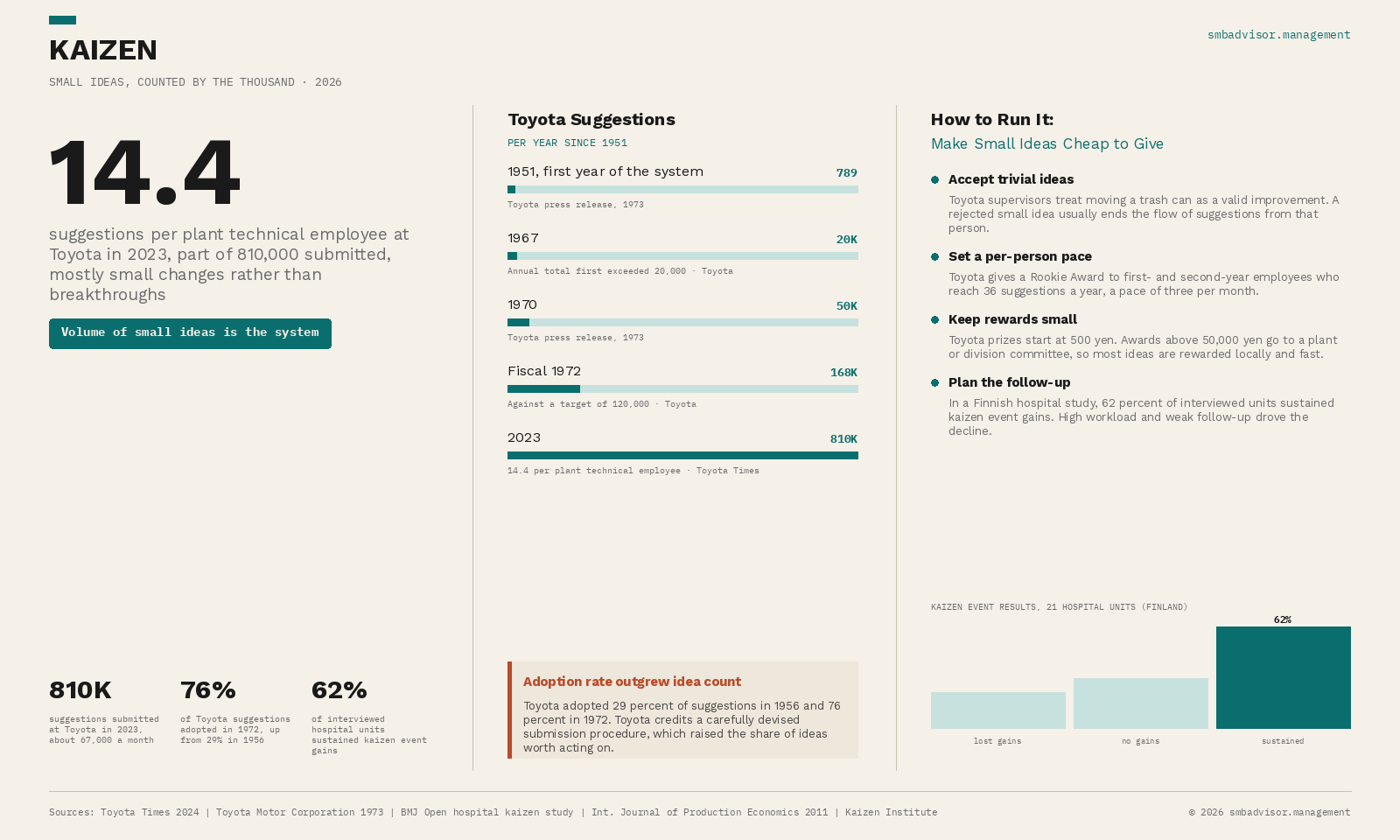
Kaizen is the practice of continuous, small, employee-driven improvement to daily work. Masaaki Imai introduced the term to Western managers in 1986. At Toyota, the system produced about 810,000 suggestions in 2023, or 14.4 per plant technical employee, and most were small changes rather than breakthroughs.
The unit of kaizen is the individual idea, not the project. A suggestion system turns that idea into a record that a supervisor can review, reward, and copy.
Adoption Rate Beats Idea Count
Toyota started its suggestion system in 1951 and received 789 ideas in the first year. By fiscal 1972, it received 168,000. The more telling number is adoption.
Toyota adopted 29% of suggestions in 1956 and 76% in 1972, after refining how employees submitted ideas. Today, employees implement and check a change first, then file the form. Prizes start at 500 yen, and new staff aim for 36 suggestions a year.
Events Fade Without Follow-Up
Kaizen events compress improvement into a few days, and the gains often decay. A study examined 26 kaizen event units in a Finnish academic hospital system. Of the interviewed units, 62% sustained results, 14% lost them, and 24% made no real gains.
High workload and weak follow-up explained the decline. A field study of 65 events in eight manufacturing organizations found that employees accepting the changes best predicted lasting commitment. None of these samples are small businesses.
Sources: Toyota Times 2024, Toyota Motor Corporation press release 1973, BMJ Open 2023 hospital kaizen study, International Journal of Production Economics 2011, Kaizen Institute