A Pattern, Not a Constant
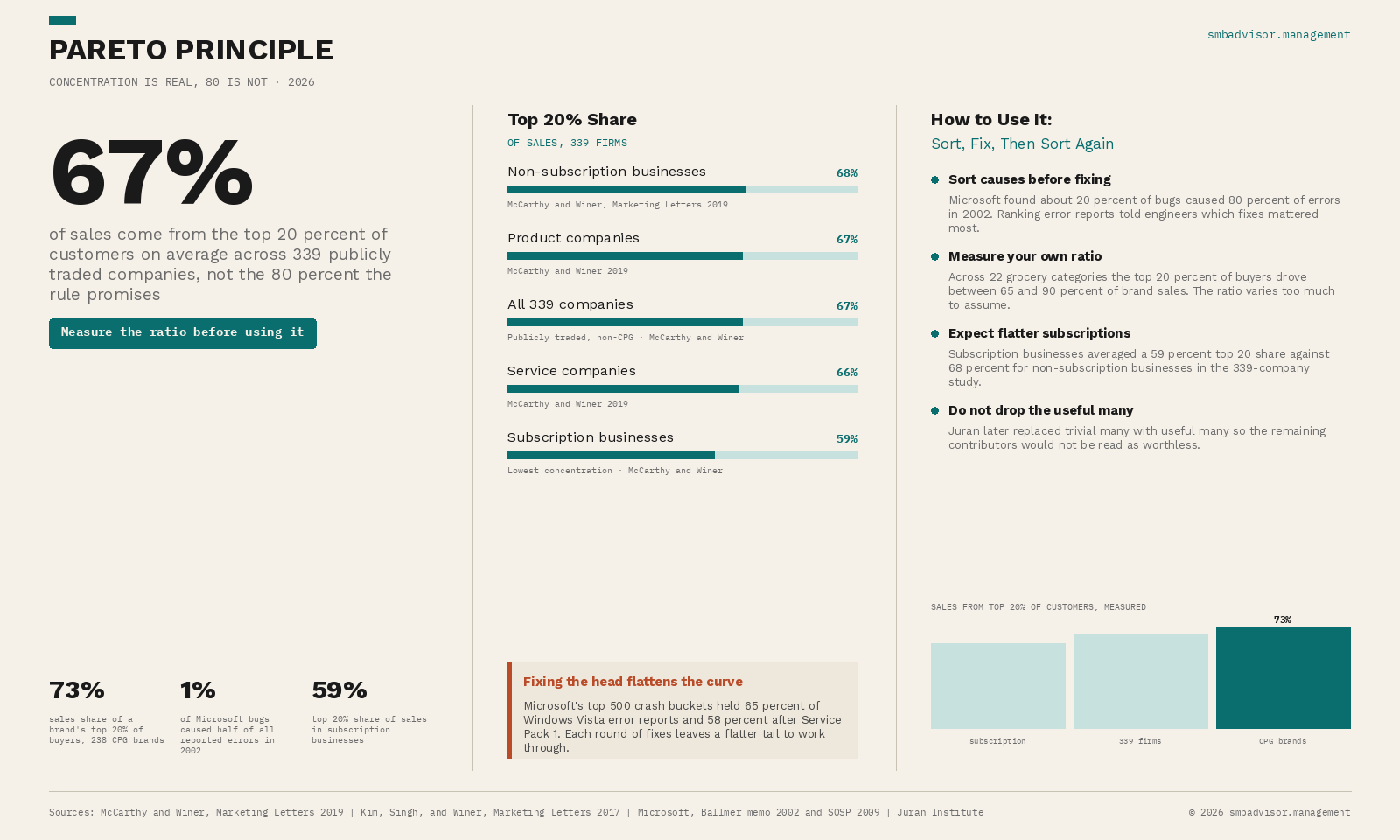
The Pareto principle is the observation that a small share of causes produces most of an effect, often shortened to the 80/20 rule. The concentration is real, but the ratio moves. Across 339 publicly traded companies, the top 20% of customers produced 67% of sales on average, not 80%.
Treat 80/20 as a prompt to measure. The measured split decides where effort goes.
Juran Named It, Pareto Studied Wealth
Vilfredo Pareto studied the unequal distribution of wealth and income and built mathematical models of it. He did not propose a universal rule. Joseph Juran noticed in the 1920s that a few quality defects accounted for most defectiveness.
He attached Pareto's name to the idea in his 1951 Quality Control Handbook and later called it the vital few and trivial many. In a 1974 essay, Juran admitted he had applied the wrong name. The familiar pea-pod story has no traceable source.
Where the Ratio Holds and Bends
Software defects come closest to the rule. In 2002 Microsoft reported that about 20% of bugs caused 80% of errors, and 1% caused half. Customer revenue is flatter.
A Nielsen panel study of 238 consumer brands found the top 20% of buyers produced 73% of sales. Subscription businesses averaged 59%. These samples come from large firms and national panels. A small business should rank its own customers, defects, or tasks before acting.
Sources: McCarthy and Winer, Marketing Letters 2019 (339 public companies), Kim, Singh, and Winer, Marketing Letters 2017 (US Nielsen panel), Steve Ballmer memo 2002, Glerum et al., Microsoft, SOSP 2009, Juran 1974