What a Performance Review Is
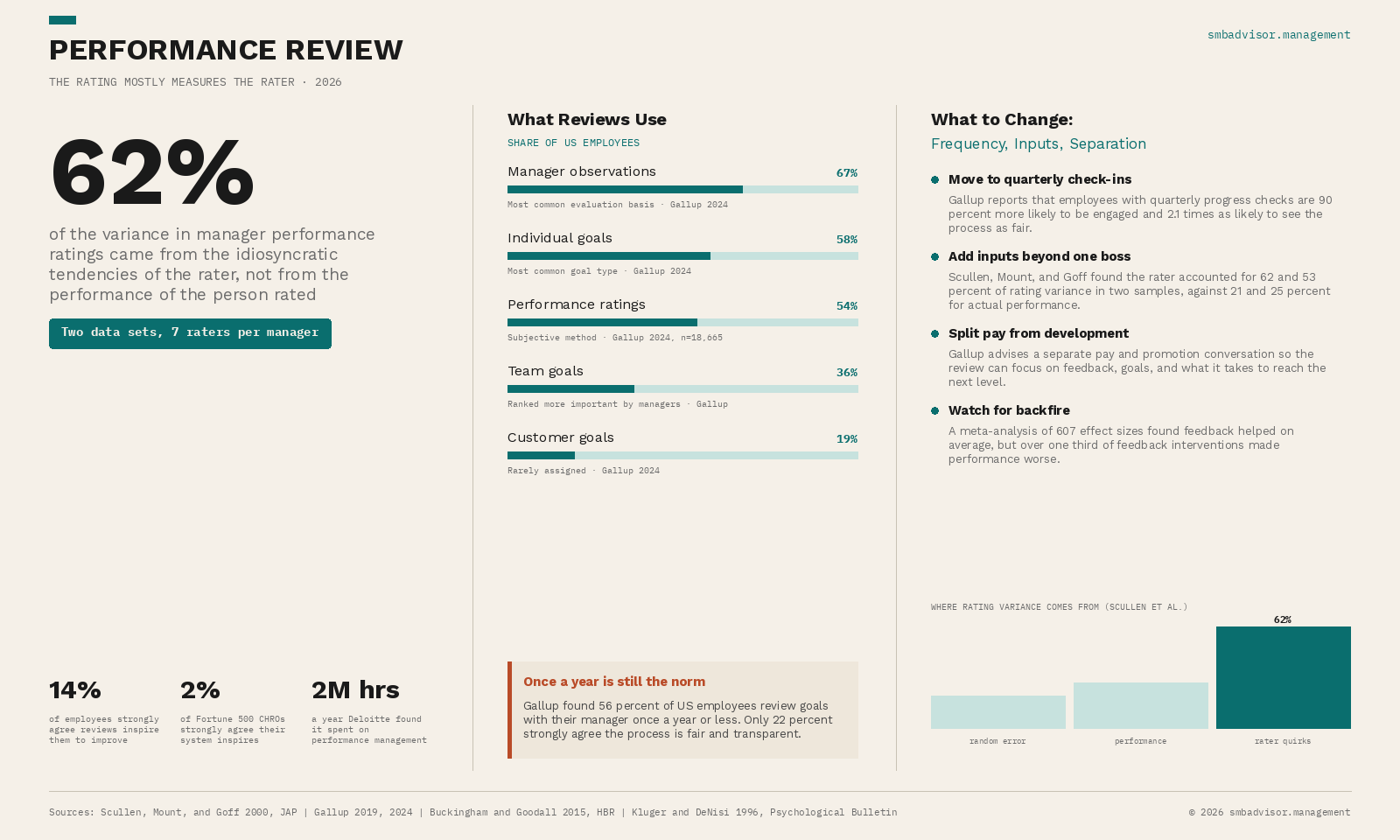
A performance review is a formal assessment, usually annual, of how well an employee met expectations, and organizations often tie it to pay and promotion. The evidence on the traditional format is poor. Gallup found only 14% of employees strongly agree their reviews inspire them to improve, and rater quirks drive most rating variance.
The format persists because it serves several purposes at once, including feedback, pay, promotion, and documentation. Packing all four into one annual conversation is the core design problem.
The Rating Measures the Rater
Scullen, Mount, and Goff studied two samples of 2,350 and 2,142 managers, with seven people rating each manager. Idiosyncratic rater tendencies explained 62% and 53% of rating variance, while actual performance explained 21% and 25%.
Deloitte, a large professional-services firm, reached the same conclusion inside its own system. Buckingham and Goodall reported that it spent close to 2 million hours a year on performance management. The firm found that ratings revealed more about team leaders than about the people those leaders rated.
What to Change
A Gallup study of 18,665 US employees found 56% review goals with their manager once a year or less. Only 22% strongly agree the process is fair and transparent. Employees with quarterly progress checks were 90% more likely to be engaged.
Among 135 Fortune 500 CHROs, only 2% strongly agree their system inspires improvement. The practical changes are clear. Hold short quarterly check-ins, add team and customer goals, gather more than one rater, and hold the pay conversation separately.
Sources: Scullen, Mount, and Goff 2000, Journal of Applied Psychology, Gallup 2019 and 2024, Buckingham and Goodall 2015, Harvard Business Review, Kluger and DeNisi 1996, Psychological Bulletin