What Quiet Quitting Measures
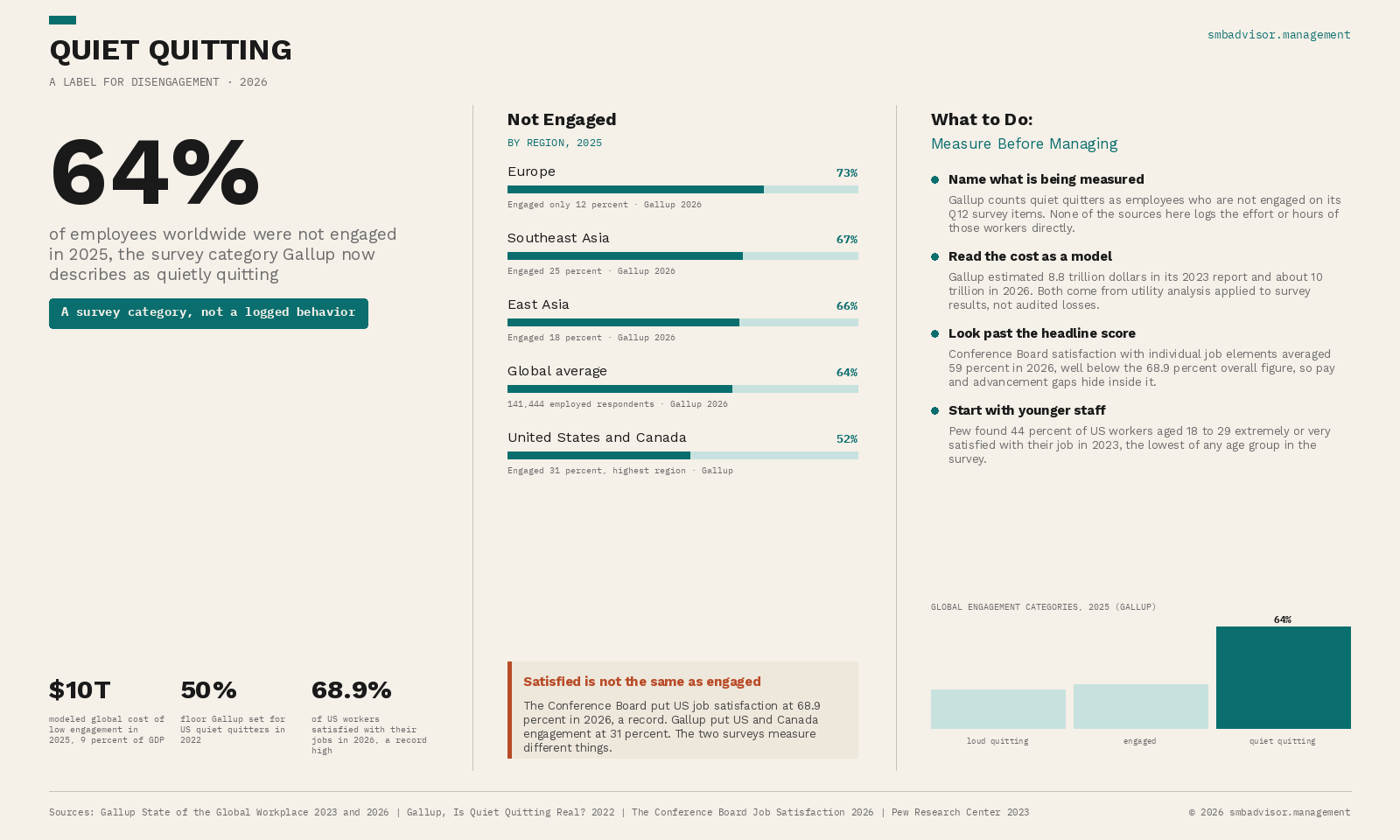
Quiet quitting is a popular label for doing the minimum a job requires while staying psychologically detached from it. Gallup maps the label onto its not-engaged category, which covered 64% of employees worldwide in 2025. The figure comes from survey answers about workplace needs, not from any direct record of effort.
The term spread on social media in 2022. That September, Gallup estimated that quiet quitters made up at least 50% of the United States workforce, based on 15,091 employees surveyed in June 2022. Only 32% were engaged, and 18% were actively disengaged, the group Gallup now calls loud quitters.
The Cost Is a Model, Not a Ledger
Gallup put the cost of low engagement at 8.8 trillion dollars in its 2023 report. The 2026 report put it at about 10 trillion dollars, or 9% of global GDP. Both figures come from a utility analysis applied to Q12 survey results.
They are modeled estimates, not audited losses. The sample is employed adults worldwide, not small firms. The regional spread is wide. In 2025, 73% of European employees were not engaged, against 52% in the United States and Canada.
Satisfaction Tells a Different Story
Other surveys complicate the picture. The Conference Board found 68.9% of United States workers satisfied with their jobs in 2026, the highest reading since 1987. Yet satisfaction with individual job elements averaged 59%.
Pew found 51% of United States workers extremely or very satisfied in February 2023. Among workers aged 18 to 29, the share fell to 44%. A worker can be satisfied and still disengaged. The practical step is to measure engagement directly, starting with younger staff, pay, and advancement.
Sources: Gallup State of the Global Workplace 2023 and 2026, Gallup 2022, The Conference Board 2026, Pew Research Center 2023