What Servant Leadership Means
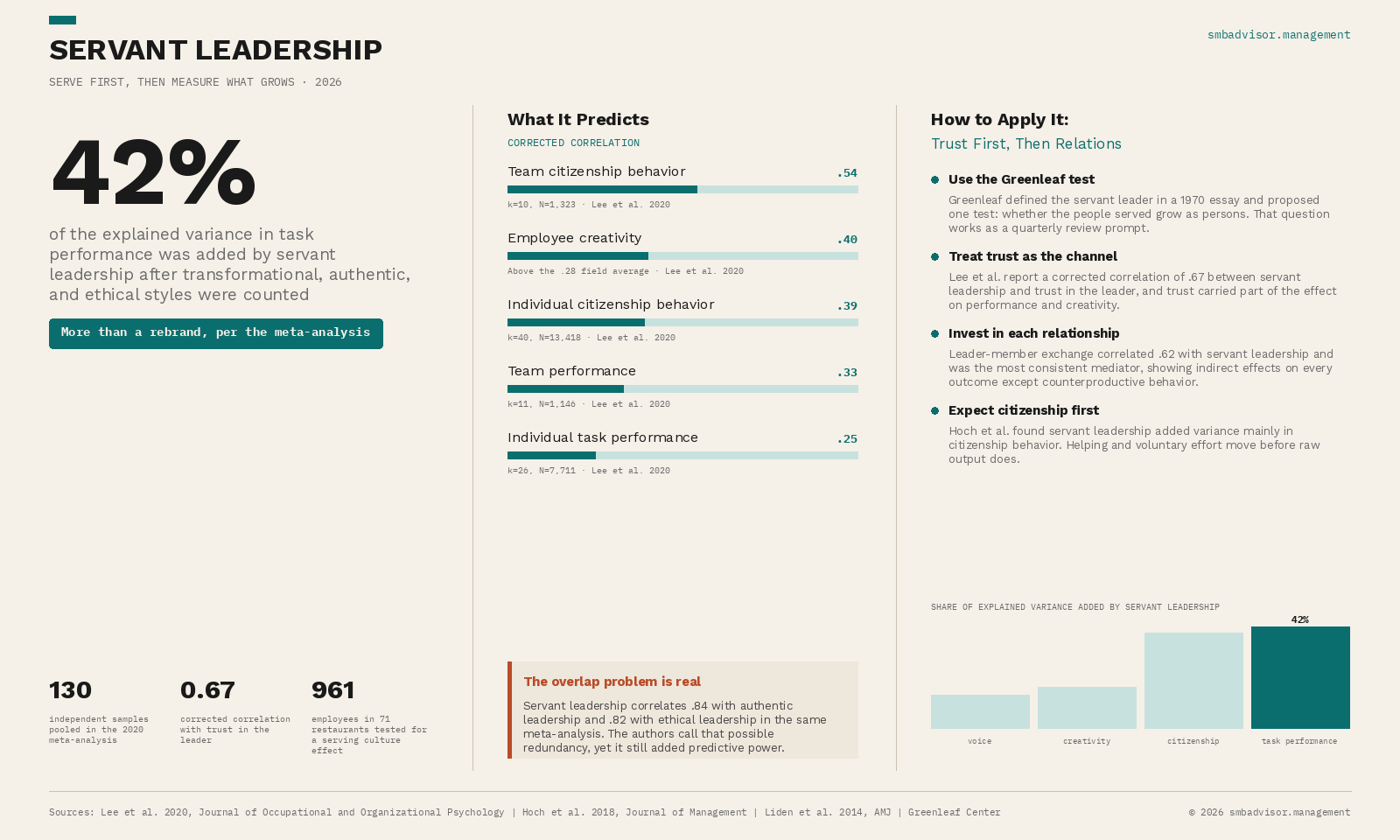
Servant leadership is an approach in which the leader serves first and leads second, putting the growth and well-being of followers ahead of personal power. Robert Greenleaf coined the term in a 1970 essay. A 2020 meta-analysis of 130 independent samples found it predicts work outcomes beyond transformational, authentic, and ethical leadership. Greenleaf proposed a simple test.
The people a leader serves should grow as persons and become more capable themselves. That test puts the measure of the leader in the team, not in the leader.
What the Meta-Analyses Show
Lee and colleagues pooled studies that appeared between 1998 and 2018. They reported corrected correlations of .39 with individual citizenship behavior, .54 with team citizenship behavior, and .25 with individual task performance. Adding servant leadership to a model that already held the three other styles raised explained variance in task performance from 14% to 24%.
Hoch and colleagues reached a narrower verdict in the Journal of Management in 2018. Servant leadership added variance beyond transformational leadership mainly in citizenship behavior, while authentic and ethical leadership added little.
Where the Evidence Is Thin
The styles overlap heavily. Servant leadership correlates .84 with authentic leadership and .82 with ethical leadership in the 2020 data. Most studies were cross-sectional, so causal claims stay tentative.
The mechanism looks relational. Trust in the leader correlated .67 with servant leadership, and the quality of the leader relationship was the most consistent route to outcomes. A field study of 961 employees across 71 restaurants in one moderately sized chain linked a serving culture to restaurant performance and lower turnover intentions.
Sources: Lee, Lyubovnikova, Tian, and Knight 2020, Journal of Occupational and Organizational Psychology, Hoch, Bommer, Dulebohn, and Wu 2018, Journal of Management, Liden, Wayne, Liao, and Meuser 2014, Academy of Management Journal, and Greenleaf Center for Servant Leadership