What Situational Leadership Means
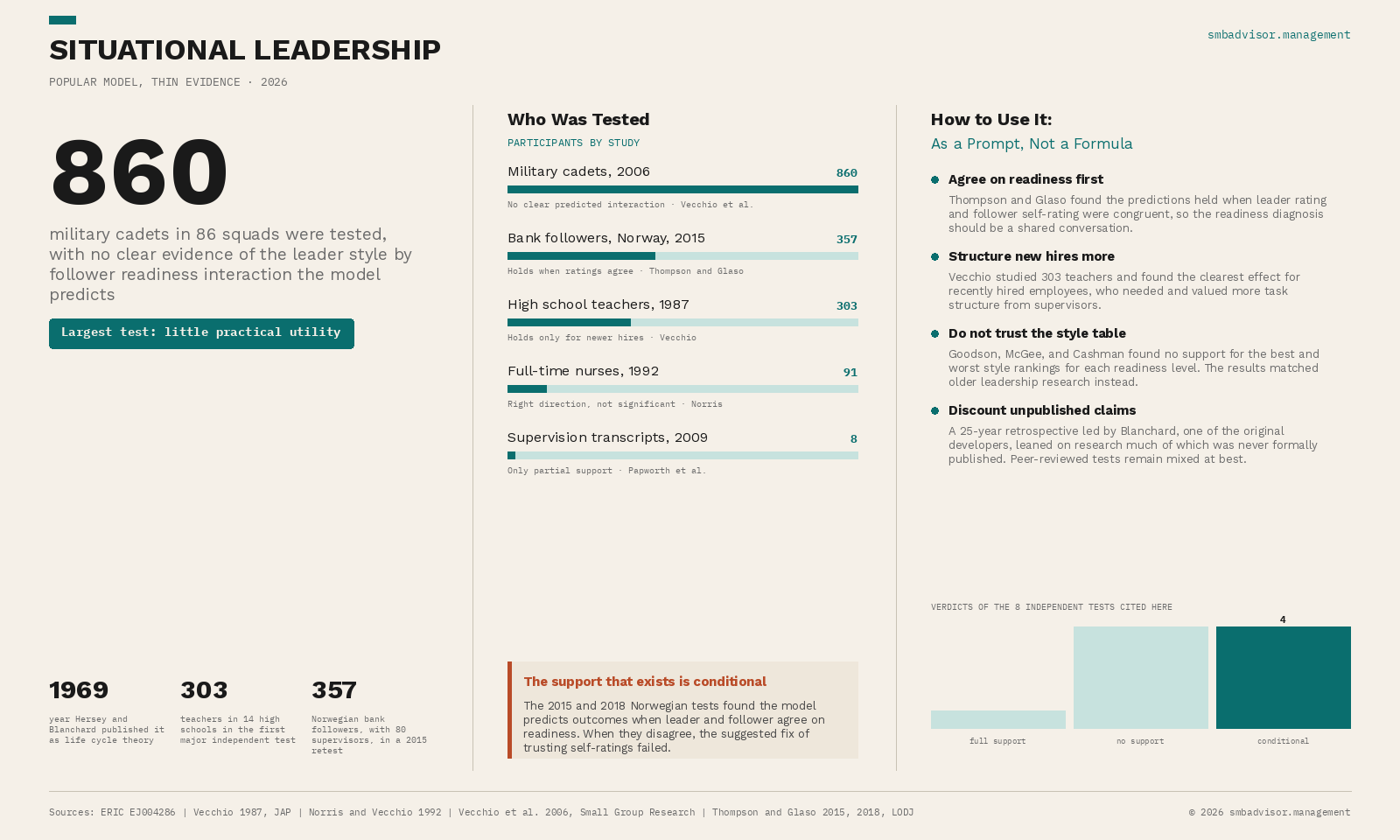
Situational leadership is a contingency model that Paul Hersey and Kenneth Blanchard first published in 1969. It tells a leader to adjust direction and support to the readiness of each follower. Independent tests have given it weak support. A 2006 study of 860 military cadets found no clear evidence of the interaction the model predicts.
The idea is intuitive. Directive leadership suits a new, unsure employee, and delegation suits an experienced, committed one. The empirical question is whether matching style to readiness actually improves results.
What the Validation Studies Found
Vecchio tested the model in 1987 with 303 teachers from 14 high schools. The prescriptions held only for certain employees, mainly recent hires who wanted more structure. A test with 91 nurses found results in the predicted direction that were not significant.
Goodson, McGee, and Cashman found no support for the core interaction or for the best-style rankings. Blank and colleagues reached the same conclusion in Personnel Psychology. The 2006 cadet study concluded the theory may have little practical utility.
What Survives and How to Use It
Later work narrowed the claim rather than rescuing it whole. Thompson and Glaso studied 80 supervisors and 357 followers in Norwegian financial organizations. The predictions were more likely to hold when leader and follower rated readiness the same way.
A 2018 follow-up confirmed that pattern but rejected the advice to rely on self-ratings when views differ. The usable lesson is modest. Agree on readiness together, give newer staff more structure, and treat the style grid as a prompt rather than a rule.
Sources: ERIC record EJ004286, Vecchio 1987, Journal of Applied Psychology, Norris and Vecchio 1992, Group and Organization Management, Vecchio, Bullis, and Brazil 2006, Small Group Research, Goodson, McGee, and Cashman 1989, Blank and colleagues 1990, Thompson and Glaso 2015 and 2018, Leadership and Organization Development Journal